

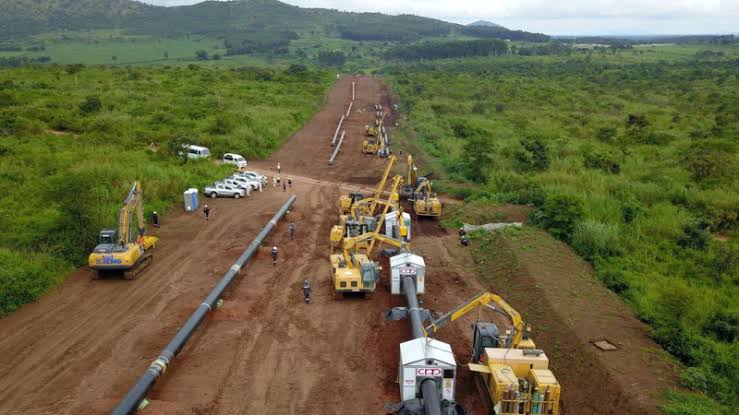
Ahead of Uganda’s first oil later this year, officials have said the 1,443-kilometer East African crude oil pipeline is ready for commissioning.
Pipeline commissioning is the final process of verifying that a new or modified pipeline system is safe, operational, and ready for service, adhering to safety and environmental standards.
This process follows pre-commissioning steps which include cleaning, gauging and hydro-testing by introducing the actual product—such as oil, gas, or water—into the system to make it live.
Speaking during the supplier development forum organised by the East African Crude Oil Pipeline (EACOP) Ltd at Sheraton Hotel in Kampala on Friday, Kamal Bouzalmata, the EACOP commissioning manager said the pipeline is at 79% completion, noting that this means it is ready for commissioning.
“When the project enters 70%, it is in completing phase. Therefore, the commissioning phase of EACOP marks a critical transition from construction to operation particularly electric infrastructure, and instrumentation, telecommunication and security,” Kamal said.
He said the commissioning will be done using the Opercom methodology developed by TotalEnergies and recognised widely as one for pre-commissioning and commissioning activities.
The method tailored to the oil and gas industry allows defining the commissioning needs in order to have the best possible transfer between the construction and the operation teams by the fastest and safest way.
Speaking on Friday, the EACOP commissioning manager said the upcoming process means that local suppliers’ services will be needed badly.
“To succeed in the commissioning, we need your support. We need to rely on you and your capabilities to achieve our target. This means a lot of opportunities for local suppliers. For example we need supply of 50 tons of nitrogen that will be used for piping leak tests at operating pressure. There will be need for supply of commissioning testing tools and equipment among other requirements that will need support from local suppliers. It is only if we don’t get them locally that we will go externally,” Kamal said.
Nick Mugira, the Managing Director for Inspecta Africa Ltd, the Tier 1 contractor for the commissioning phase said only prepared local suppliers will be able to grab the various opportunities available in the commissioning phase.
“The opportunities in EACOP are available but as local companies, we have got to prepare ourselves for them. While opportunities are here, you need to do something to present yourself so that you are seen and known. If you don’t put it on paper and show your certifications it is very difficult you will be picked,” Mugira said.
“These are specialised jobs and they won’t pick you because you have written. You must show there is something you have done. Document and market yourselves. Local companies have an advantage because everyone wants to work with them. They will however not work with a company that has not prepared itself. Opportunity only meets those who are prepared.”
According to officials, the 1442km East African crude oil pipeline will have six pumping stations, two pressure reducing stations, two control rooms on either end, 76 remote control block valves and five solar farms to power pumping stations.
