

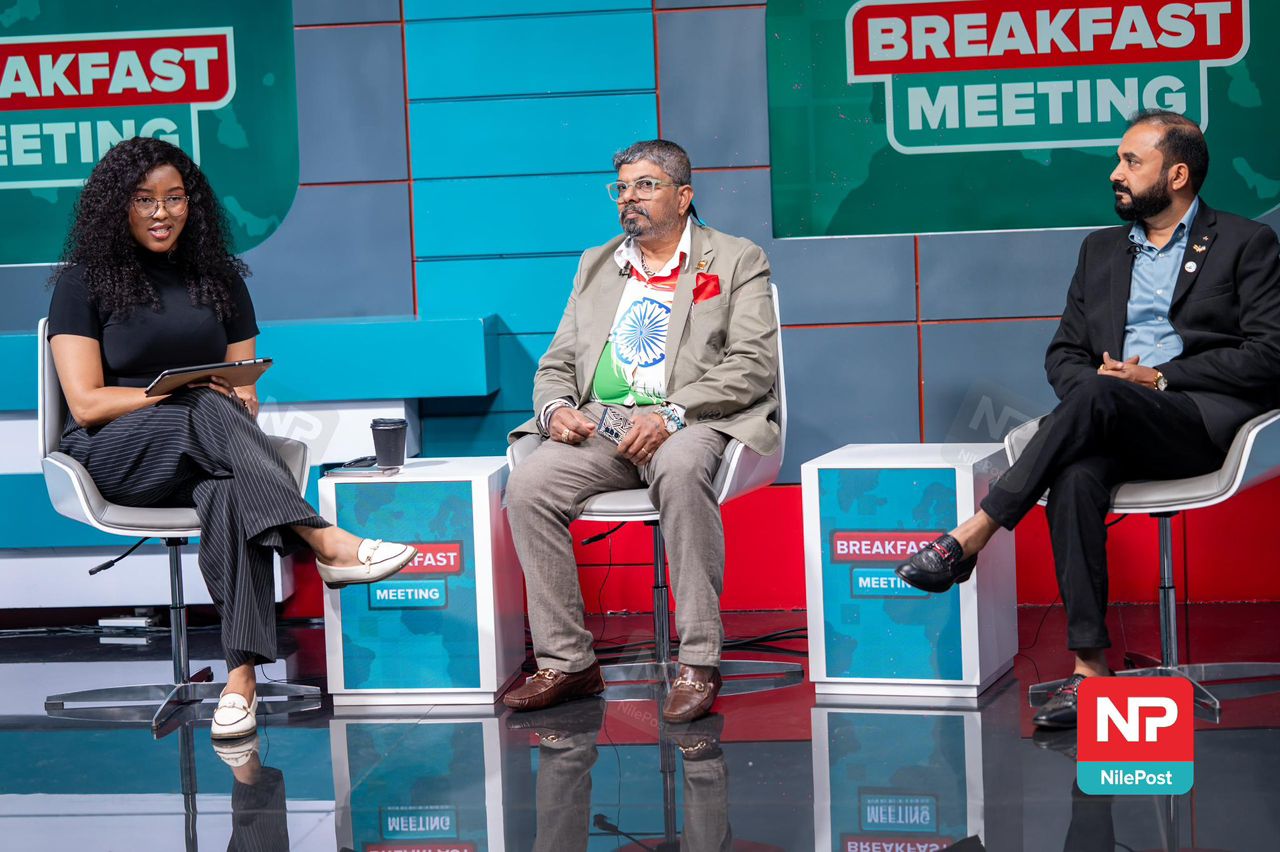
Leaders from Uganda’s Indian community have reaffirmed their deep-rooted commitment to the country’s economic and social development, citing decades of contribution, resilience and partnership with the Government of Uganda.
Speaking during the NBS Breakfast Meeting on Friday, Paresh Mehta, Acting Chairman of the Indian Association Uganda, described the Indian community as united and service-oriented, guided by values that emphasise shared global responsibility.
“Our culture teaches us that the world is one family, so wherever we go, we contribute to that country’s growth,” Mehta said.
He praised the ruling National Resistance Movement (NRM) government for providing a stable and investor-friendly environment, noting that peace and policy predictability have been critical to long-term investment and business growth.
“The NRM government has provided a stable atmosphere with investor-friendly policies. There is no country like Uganda for investors. This country has given us peace, stability and strong returns on investment,” he said.
Although people of Indian origin make up less than one percent of Uganda’s population, Mehta said their contribution to the national economy remains significant.
“According to Uganda Revenue Authority statistics, our contribution accounts for about 65 percent of the country’s revenue,” he said.
Also speaking at the event, Tharun Patnaik, founder of Freedom Factory, said the Indian community’s role extends beyond commerce into social development and public service.
“Indians have contributed to building schools and hospitals, not only in Kampala but across Uganda. We have contributed across all sectors, including supply chains, industrialisation, job creation and social responsibility,” Patnaik said.
As of 2025, Uganda is home to an estimated 50,000 people of Indian origin, down from nearly three times that number in the mid-20th century.
Indian migration to Uganda largely took place during the British colonial period, when both India and Uganda were under British rule. Tens of thousands were brought to East Africa, often as indentured labourers or low-wage workers, to help construct railways and develop infrastructure. Over time, many transitioned into trade and business, becoming an integral part of Uganda’s economic and cultural fabric.
This period of relative stability was disrupted in 1972, ten years after independence, when dictator Idi Amin ordered the expulsion of South Asians from Uganda, giving them just 90 days to leave. Tens of thousands were forcibly displaced, with many resettling in the United Kingdom and Canada as refugees.
Following the fall of Amin’s regime, Uganda gradually stabilised. Although racial and economic divisions persisted, the country became safer, prompting many Indians to return, rebuild businesses and renew their contribution to national development.
Several prominent global figures trace their roots to Indian-Ugandan families, including New York City Mayor Zohran Mamdani, British actress Naomi Scott, Canadian actor Avan Jogia, and British pop singer Charli XCX.
