

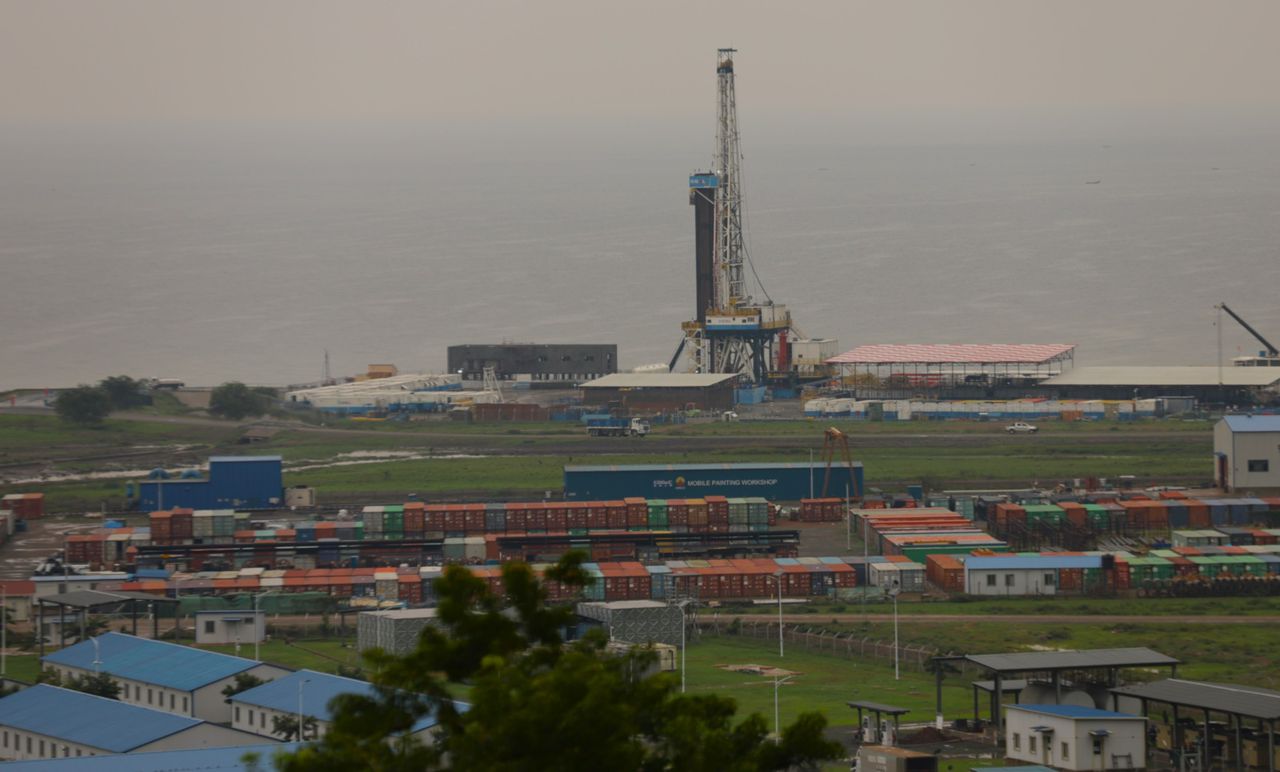
The journey towards Uganda’s long-awaited first oil has taken a major leap forward after CNOOC Uganda Limited confirmed the successful drilling of 15 wells at the Kingfisher oil project in Kikuube District.
With only 16 more to go before full-scale production, the milestone signals Uganda’s readiness to enter the oil production era.
Dennis Mulondo, a geologist at CNOOC Uganda Limited, explained the progress and the science behind the drilling operations.
“We have the onshore drilling operations on which we're going to build 31 wells on four pads. The 31 wells will have 20 producers, and 11 are water injectors," Mulondo said.
"The purpose of the injectors is you pump water into them, then it pushes the earth towards the producers to increase the amount of oil which you can produce."
He further explained the infrastructure that will handle crude oil once it starts flowing.
“We have the lake water upstream station. We shall be drawing a good amount of water from the lake to support the operations and also for injection purposes," Mulondo said.
"Then we have the flow lines connecting the four pads to the Central Processing Facility (CPF). When oil is produced, it comes with sand, water, and gas. At the CPF, we remove the sand and water so that only crude oil is left. We then pump the crude oil through an eight-kilometre pipeline from the CPF to Kabaale."
Despite the progress, Mulondo stressed that actual oil production can only begin once export and refining infrastructure is ready.
“These 15 wells are sufficient. We needed 15 wells for first oil, so as a building part we are ready to produce. But as I have said, EACOP is not yet ready. The government also has a very big interest in the refinery, which is not yet ready," he said.
"The President is very key on that—he wants not all the oil to be taken out of the country. So until those two are complete, we cannot produce oil. The wells are there, but without transport or refining, production cannot begin."
The Executive Director of the Petroleum Authority of Uganda, Ernest Rubondo, confirmed the significance of the progress.
“The Kingfisher project is supposed to have a total of 31 wells, and CNOOC Uganda Limited is moving very well. To start production, they need about 17 wells. If they have done 15, you can see how close they are getting to being ready for oil production. The other wells will be drilled even after production has begun,” Rubondo said.
He praised the cooperation of local residents but cautioned against misinformation.
“The company has worked very well with the community. I would like to thank the communities for this support. The only challenges have come from some civil society organizations that have been funded by foreigners, but the communities have identified them and continue to support the project.”
On the export side, the East African Crude Oil Pipeline (EACOP) remains the critical link to international markets. John Bosco Habumugisha, Deputy Managing Director of EACOP, reassured Ugandans about progress on the pipeline.
“We are building an intelligent, innovative and sustainable pipeline system using green energy. We are using only hydropower. Uganda will be supplying power through UETCL while Tanzania will supply through Tanesco," he said.
"Beyond that, we are working with communities to ensure that we contribute to sustainable development where we operate. In the second half of next year, we should be able to see completion of this project. That is when we can talk about the world’s first oil."
Derrick Jonathan Mbabazi, National Content Manager for the EPC III Project, emphasized Uganda’s participation in the oil economy.
“National content refers to the degree through which Ugandan citizens, resources and local companies participate in the oil and gas industry.
We are committed to fulfilling our obligations, one of them being employment of Ugandans. We have employed over 2,000 Ugandans on the Central Processing Facility, including 500 from local communities, many of whom have been trained and certified in trades like welding and scaffolding,” he said.
With 15 wells already drilled, Uganda is inching closer to first oil—a milestone that has been nearly two decades in the making since discoveries were first confirmed in 2006.
The final stretch now depends on the timely completion of the refinery and the 1,443-kilometre EACOP pipeline, which will carry Uganda’s crude oil to the Tanzanian coast for export.
