

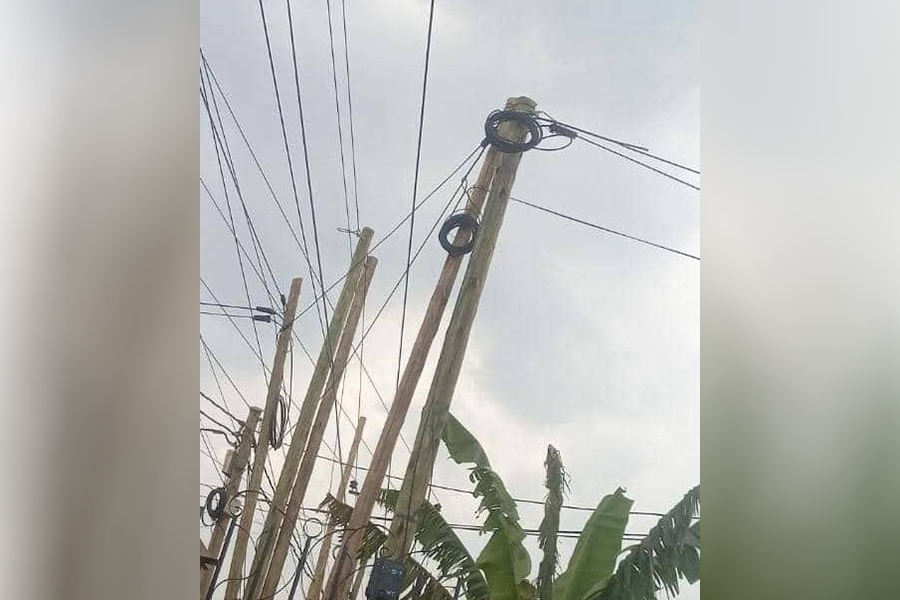
The Uganda Communications Commission (UCC) has directed telecommunications operators to streamline infrastructure deployment following growing concerns over the duplication of utility poles and uncoordinated fibre installations, particularly in the Greater Kampala Metropolitan Area.
In a public notice issued Monday, the regulator said the increasing clutter of poles and fibre cables has created safety risks, disrupted urban planning, and undermined the aesthetic appeal of urban areas.
To address the problem, UCC introduced a new Framework for Optical Fibre Installation, Maintenance, Protection and Disposal, which took effect on January 1, 2026.
The framework requires telecom operators to obtain prior approval for fibre deployment plans before installation, a move aimed at ensuring coordinated and efficient rollout of telecommunications infrastructure.
The Commission said the directive targets long-standing challenges where multiple service providers install parallel infrastructure along the same routes, causing congestion, duplication, and higher maintenance risks.
UCC emphasized stronger collaboration with local governments, noting that telecom infrastructure must be integrated into broader urban planning processes, including road construction and other civil works.
“Telecommunications infrastructure must be appropriately integrated into development planning to avoid conflicts and damage,” the Commission said in the notice.
Operators are also encouraged to adopt underground fibre deployment where possible to enhance safety and reduce visual clutter in urban centres.
However, UCC cautioned that civil works must be undertaken carefully to avoid damaging existing fibre networks, warning that such disruptions can significantly affect service delivery and network quality.
The regulator said it will work closely with government agencies, local authorities, and private operators to enforce compliance and ensure a more organized and future-ready telecommunications network.
The move comes amid rapid expansion of internet and data services in Uganda, driven by increasing smartphone usage, digital financial services, streaming services, and government digitalization programs such as e-government platforms and digital tax systems.
Since the liberalization of Uganda’s telecom sector in the late 1990s and early 2000s, operators such as MTN Uganda, Airtel Uganda, and Liquid Intelligent Technologies have expanded fibre networks across major towns and cities to support high-speed internet and data services.
However, uncoordinated rollout has been a persistent challenge, as each provider historically sought to own and control its physical infrastructure to maintain service quality and competitive advantage.
This has resulted in “overbuild,” where multiple companies install separate poles and fibre cables along the same streets, particularly in high-income and commercial areas where demand for fibre internet is highest.
Urban planners and city authorities have raised concerns about infrastructure congestion in areas such as Kololo, Nakasero, and the Kampala Central Business District, where the weight of multiple fibre bundles has in some cases caused poles to lean or wires to sag, creating safety risks and obstructing pedestrian walkways.
Building parallel infrastructure is also expensive. By enforcing coordination, UCC is promoting infrastructure sharing, where multiple operators use the same poles, ducts, or underground trenches, lowering capital expenditure per company and improving efficiency in network expansion.
Industry experts say infrastructure sharing can reduce network rollout costs by up to 40 percent, savings that could eventually translate into lower internet and data costs for consumers.
Another major concern raised by the Ministry of Works and Transport and the Kampala Capital City Authority (KCCA) has been poor synchronization between road construction and telecom infrastructure deployment.
In several cases, roads are paved only for telecom companies to dig trenches shortly afterward to lay fibre cables, increasing maintenance costs and damaging newly constructed roads.
The new directive aligns with the “Dig Once” policy approach, where telecom operators are required to coordinate with road agencies and city authorities so that fibre ducts are installed at the same time as road construction and other underground utilities such as water and electricity.
UCC is also encouraging the industry to shift toward underground trenching rather than aerial fibre deployment. While aerial fibre installed on poles is cheaper and faster to deploy, it is more vulnerable to accidents, falling trees, vandalism, and weather damage.
Underground fibre, though more expensive initially, is more stable, more secure, and preserves the urban landscape.
The new framework also introduces stricter rules on disposal of old or unused infrastructure, addressing the long-standing problem of abandoned cables and redundant poles left along roadsides.
Under the new rules, telecom operators must seek prior approval for fibre deployment, prioritize underground or shared infrastructure, coordinate with local governments and road agencies, and properly remove obsolete infrastructure.
Regulators say the reforms are aimed at building a more efficient, safer, and better coordinated telecommunications network as Uganda continues to expand broadband connectivity and digital infrastructure nationwide.
