

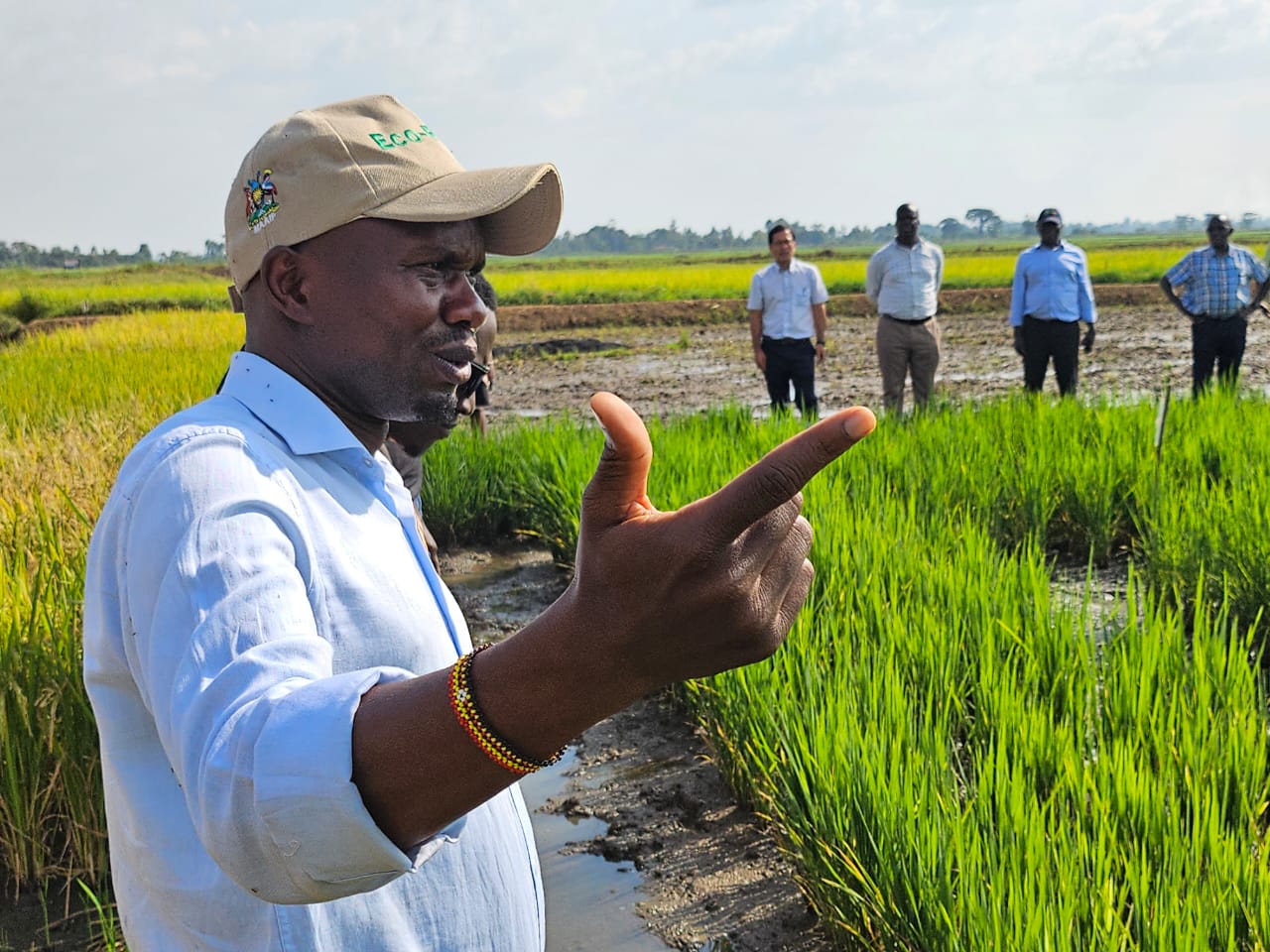
Uganda is edging closer to a major agricultural milestone as scientists finalize testing of new aromatic rice varieties expected to rival—and potentially replace—popular imported basmati and supa rice.
The varieties, developed by the National Agricultural Research Organisation (NARO) with support from the Japan International Cooperation Agency (JICA), are designed to meet soaring domestic demand for aromatic rice while addressing long-standing challenges of low yields and disease susceptibility among locally grown varieties.
The breakthrough is being delivered under the five-year Promotion of Sustainable Rice Development (ECO-PRiDe) Project, which aims to boost farmer incomes, enhance food security, and significantly reduce Uganda’s reliance on costly rice imports.
According to Dr. Jimmy Lamo, a rice breeder and Cereals Program Leader at NARO, the new aromatic rice lines have been developed using disease-resistant parent seeds and are now in advanced stages of evaluation.
“Aromatic rice dominates the market, but the varieties currently grown in Uganda are highly susceptible to disease and give low yields,” Dr. Lamo said. “We have developed improved lines that combine aroma, grain quality, and higher productivity. These are under advanced multi-location testing, including at the Doho Irrigation Scheme in Butaleja.”
Dr. Lamo made the remarks during the second Joint Technical Committee (JTC) Meeting of the ECO-PRiDe Project, held on December 11, 2025, at City Resort Hotel in Butaleja District. The meeting was hosted by NARO’s Buginyanya Zonal Agricultural Research and Development Institute (BugiZARDI).
He revealed that farmers, millers, and other rice value chain actors are actively involved in cooking and milling evaluations—critical final steps before the varieties are submitted for approval by the Ministry of Agriculture, Animal Industry and Fisheries (MAAIF) and the National Variety Release Committee.
Beyond improving yields and quality, the project places strong emphasis on sustainable and climate-resilient rice production.
Dr. Titus Alicai, Director of Research at the National Crops Resources Research Institute (NaCRRI) and National Project Coordinator for ECO-PRiDe, said the initiative is developing an evidence-based blueprint to increase rice productivity while reducing environmental impact.
“Our goal is to increase rice production without harming the environment, while improving incomes for rural farmers,” Dr. Alicai explained. “This involves producing high-quality seed, strengthening farmer knowledge on sustainable cultivation practices, and improving efficiency across the entire rice value chain.”
Now in its second year, ECO-PRiDe brings together researchers, extension workers, seed companies, farmers, academia, and government agencies. The project aligns with NARO’s Strategic Plan 2025–2030, particularly its focus on climate-resilient agricultural systems.
Dr. Kisho Miyamoto, Chief Advisor for the ECO-PRiDe Project, said the initiative is drawing on Japan’s more than 2,000 years of experience in rice production to support Uganda’s ambitions.
“Beyond research, we are ensuring last-mile delivery—bringing quality seed, disease management knowledge, and sustainable production practices directly to farmers,” Dr. Miyamoto said.
He added that the project supports capacity building by facilitating young Ugandan researchers to undertake studies at Japanese universities, while also strengthening farmer learning through the Musomesa Field School approach, which enhances the link between research, extension services, and on-farm application.
At the Doho Irrigation Scheme, where several of the new aromatic varieties are being tested, adoption of improved rice production technologies is already evident.
Dr. Nasser Kasozi, Director of Research at BugiZARDI, noted that many farmers at the scheme have embraced practices introduced through the project, resulting in improved productivity. He also highlighted ongoing trials of rice–fish integration technologies, where nutrient-rich water from fish ponds is used to fertilize rice fields—boosting yields while improving household nutrition and incomes.
In addition, BugiZARDI is developing a comprehensive cropping calendar aimed at improving water-use efficiency and stabilizing production throughout the year.
During a site inspection at the Doho Irrigation Scheme, members of the Joint Technical Committee observed tangible progress in both research and farmer adoption. With new aromatic rice varieties nearing release and sustainable innovations gaining traction, Uganda appears poised for a more competitive and self-reliant rice sector.
Once approved, the locally developed aromatic varieties could mark a turning point—reducing import dependence, strengthening rural livelihoods, and positioning Uganda as a regional player in high-quality rice production.
