

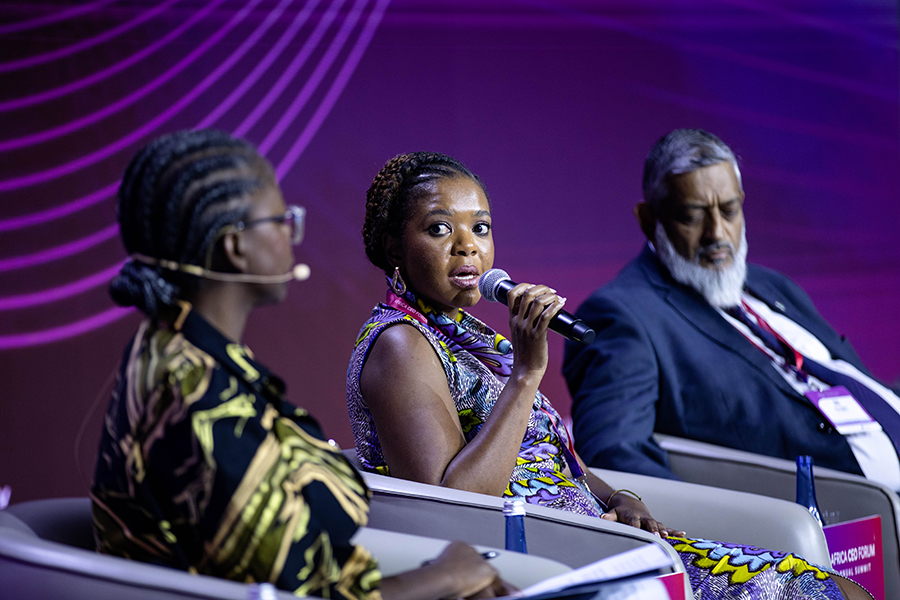
KIGALI — South Africa has used the Africa CEO Forum in Kigali to present itself as a willing partner to African countries, calling for stronger economic ties, deeper collaboration, and increased intra-African investment as the continent seeks to translate integration commitments into practical business outcomes.
The forum, held from May 14 to 15 in Kigali, brought together heads of state, policymakers, business leaders, and investors to discuss Africa’s economic transformation agenda.
Speaking during the “Invest in South Africa” session on the margins of the forum, officials and business leaders said South Africa was positioning itself not just as a destination for capital, but as a continental partner for shared industrial and economic development.
Mmaphuthi Rankapole, Chief Marketing Officer of Brand South Africa, said the country’s message in Kigali was centered on partnership and co-creation.
“We are here as partners, as family, and as co-builders of the nations that we share,” she said, adding that South Africa’s invitation to the continent was about “new ways of investing, new ways of building, new ways of partnering across this fantastic continent.”
The discussions took place against the backdrop of renewed efforts to operationalise the African Continental Free Trade Area, which aims to expand intra-African trade by reducing tariffs and easing cross-border trade barriers.
Willem Van Der Spuy, Acting Deputy Director-General of Exports at South Africa’s Department of Trade, Industry and Competition, said the agreement responds directly to long-standing concerns raised by businesses across the continent.
“AfCFTA addresses some fundamental requirements that business has been asking for: improving market size, reducing logistical challenges, and tackling tariffs and other barriers,” he said.
He added that Africa’s growth depends on countries working more deliberately together, arguing for a shared continental development approach rather than fragmented national strategies.
Rankapole said South Africa sees Africa’s economic potential as clear, but warned that global perceptions continue to limit investment flows into the continent.
“Perception is now an economic asset,” she said, noting that narratives around instability and risk continue to influence how international capital engages Africa.
She said changing these perceptions is not just a branding exercise but an economic necessity for unlocking investment.
South Africa presented itself as a platform for continental investment across sectors including renewable energy, agriculture, mining, automotive manufacturing, logistics, financial services, tourism, and the digital economy.
However, speakers also highlighted persistent structural challenges, particularly high logistics costs and fragmented transport systems that continue to hinder intra-African trade.
Mohammed Akoojee, Chief Executive Officer and Managing Director for Africa at DP World, said Africa must move towards an integrated logistics system rather than country-by-country approaches.
“We need to start thinking about logistics costs from source to destination — not just the landside cost in one country,” he said.
He added that Africa requires an integrated, multi-modal logistics system to support trade expansion under AfCFTA.
Luna Nevhutalu, Head of Institutional Sales for Global Markets at Rand Merchant Bank, said investor interest in African infrastructure and sustainable finance is growing, but called for better risk structuring to attract long-term capital.
The Kigali discussions ultimately framed South Africa’s message around partnership and shared growth, with officials arguing that Africa already has the tools—through trade integration, logistics reform, and financial cooperation—to convert ambition into bankable economic opportunities.
