

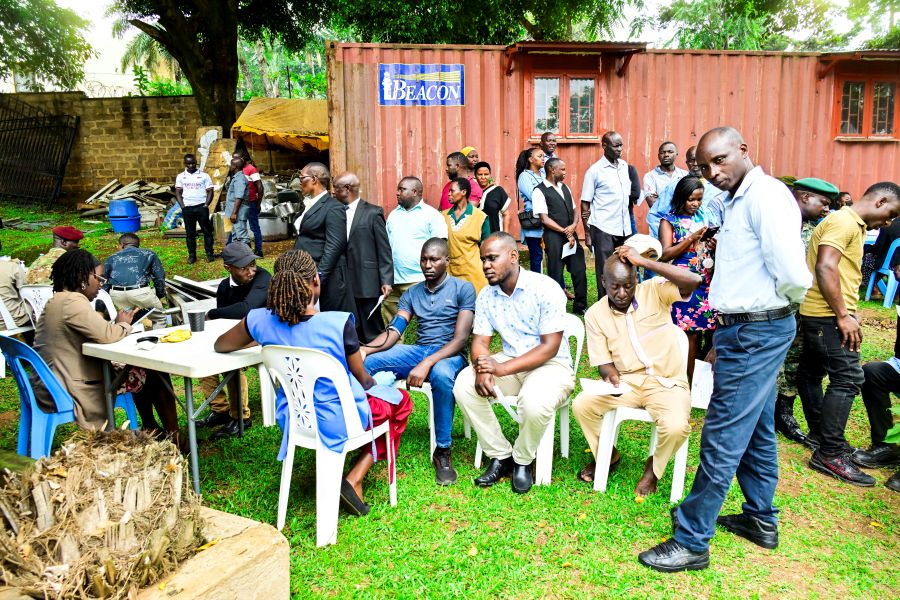
The State House has this week held a health camp under its HIV and Tuberculosis (TB) mainstreaming program, aimed at raising awareness and strengthening the fight against communicable and non-communicable diseases among staff and the wider public.
Organized by the State House Medical Department, the initiative brought together government officials, medical experts, civil society actors, and faith leaders to emphasize prevention, testing, and treatment as Uganda pushes towards its goal of ending HIV and AIDS as a public health threat by 2030.
Health as a foundation for productivity
Opening the event on behalf of the State House Comptroller, Ms. Jane Barekye, Mr. Benon Twinobusingye, Assistant Commissioner and Head of Human Resources at State House, underscored the importance of investing in the health and well-being of staff.
“The main objective of this camp is to continuously raise awareness about TB, HIV, AIDS, cancer, and other diseases that threaten our people. The National Development Plan emphasizes health promotion as a fundamental human right for all Ugandans,” he said.
He recalled the recent loss of a staff member to Hepatitis B as a painful reminder of the urgency of such interventions, stressing that good health is central to productivity not only at State House but across the nation.
Despite progress in treatment, he noted, Uganda still faces enormous challenges: “We risk falling short of the 2030 target to end HIV and AIDS as a public health threat. Similarly, TB continues to take a big toll on the national health budget.”
Dr. Elijah Ssemaganda, Assistant Director of the State House Health Monitoring Unit, highlighted the importance of health checks, urging staff and the public to embrace prevention.
“If today we can achieve the goal of public awareness and encourage people to go for health checks, then we shall be good to go,” he said. He also called for more blood donation, describing it as a “lifesaving commodity which only our bodies can produce.”
Providing an update, Mr. Tom Etii of the Uganda AIDS Commission praised the President’s four decades of leadership in the fight against HIV and the First Lady, Maama Janet Museveni, for championing the elimination of mother-to-child transmission.
He revealed that 1.5 million Ugandans live with HIV, of whom 1.3 million are on treatment, at a cost of shs1.4 trillion annually. However, 37,000 new infections were recorded last year, with 20,000 AIDS-related deaths.
“That means every hour, five Ugandans get infected, and every day, 100 new cases are registered. About 57 Ugandans die every week from AIDS-related illnesses,” he said.
He attributed the persistence of new infections to multiple sexual partnerships, transactional sex, low condom use, and complacency among men who shun testing and treatment.
He urged men to take responsibility, protect young women and girls, and combat rising teenage pregnancies tied to HIV transmission routes.
Testimony of resilience
Rev. Canon Gideon Byamugisha, Africa’s first priest to publicly declare his HIV-positive status, shared a moving testimony of living openly with the virus for over 30 years alongside his wife, Pamela.
He recounted experiences of stigma, including being expelled from hotels abroad.
“In Indonesia, we were thrown out of a hotel after people discovered we were HIV-positive. The manager even burned the mattresses and blankets we had used.”
Despite discrimination, Canon Byamugisha has remained a strong advocate for openness, testing, and treatment adherence.
“Science is enough to end AIDS. We have the medicines, the leadership, and the means. What is preventing us is stigma and complacency,” he said.
Scientific advances in HIV prevention
Dr. Flavia Matovu Kiweewa, Director of Research at the Makerere University–Johns Hopkins University (MUJHU) Research Collaboration, outlined new prevention interventions, including Pre-Exposure Prophylaxis (PrEP), a daily pill that significantly reduces infection risk.
She noted that adherence remains a challenge, especially among mobile populations such as young women in mining, fishing, and hospitality sectors, due to stigma associated with the drugs.
She also highlighted long-acting options like the dapivirine vaginal ring and emphasized prioritizing pregnant women to eliminate mother-to-child transmission.
Collective responsibility in health promotion
The health week brought together officials from the Ministry of Health, Uganda Cancer Institute, Uganda Blood Transfusion Service, and Uganda AIDS Commission.
State House was commended for allocating 0.1% of its resources to HIV and TB mainstreaming, setting an example for other government institutions.
Speakers emphasized collective responsibility in combating HIV, TB, cancer, and other diseases. They urged staff, parents, and communities to embrace regular health testing, seek treatment without fear of stigma, donate blood, and adopt healthy lifestyles.
