

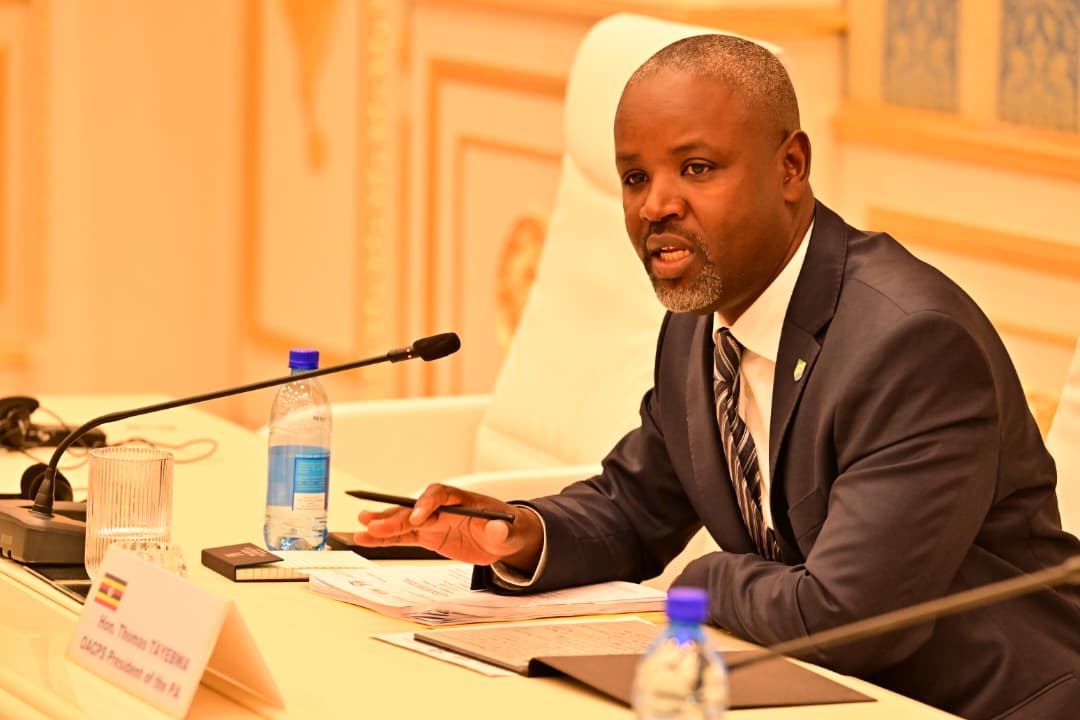
Uganda’s Deputy Speaker of Parliament, Thomas Tayebwa, has urged African legislators to push back against what he termed as growing interference by the European Parliament in the internal affairs of African countries, calling for mutual respect and protection of sovereignty under international partnerships.
Tayebwa, who also serves as President of the Organization of African, Caribbean and Pacific States (OACPS) and Co-President of the OACPS–EU Joint Parliamentary Assembly, made the remarks during a meeting of the Eastern Africa Regional Parliamentary Group held in Ezulwini Valley.
“I think we need to caution our colleagues from the European Parliament to reduce interference in the matters of our countries,” Tayebwa said.
“We have not interfered in how they are doing their things with Russia. They should leave our countries alone,” he added.
Tayebwa criticized the European Parliament’s move to pass a resolution against Uganda’s January 2026 general elections and summon Uganda’s ambassador, despite earlier assessments by EU observers that reportedly described the polls as free and fair.
He said a similar incident had also occurred in Tanzania, where the country’s ambassador was summoned following elections.
“Such actions contradict the principles of mutual respect outlined in the Samoa Agreement under which the OACPS–EU Parliamentary Assembly operates,” Tayebwa said.
Referring to previous disagreements between African states and the European Parliament, Tayebwa recalled the European Parliament’s 2022 resolution seeking to halt the construction of the East African Crude Oil Pipeline, which he said was later withdrawn following resistance from African leaders during an OACPS meeting in Maputo, Mozambique.
“This demonstrates the value of standing firm against what is not right,” he said.
Ugandan legislators attending the meeting backed Tayebwa’s position, questioning the credibility of international agreements if African sovereignty is not respected.
Maurice Kibaalya argued that the European Union’s actions risk undermining trust in international partnerships.
“How can we trust the agreements we are signing? Uganda ratified the Samoa Agreement in good faith, yet a parliament of another bloc is interfering in the affairs of an independent country,” Kibaalya said.
“The Samoa Agreement clearly provides for respect for sovereignty and diplomatic processes. Unilateral actions could discourage African states from committing to future agreements,” he added.
Amos Kankunda also condemned what he described as external interference in domestic governance.
“We really condemn in the highest terms possible the idea of mingling in our internal politics. We should be allowed to manage our own internal affairs as independent states,” Kankunda said.
Similarly, Dickson Kateshumbwa stressed that sovereignty must remain central in all international engagements.
“The independence that comes with ratifying agreements like the Samoa Agreement must be respected. We condemn in the strongest terms any interference in our internal political processes,” Kateshumbwa said.
Tayebwa challenged African legislators to adopt a more united approach to international negotiations by identifying clear shared priorities for the continent.
“We must get one or two clear riding points that bring us together as Africa,” he said.
“While other regions like the Caribbean are united by common challenges such as climate change, Africa must be more deliberate in defining its collective agenda,” he added.
He warned that European negotiators are often highly prepared and detail-oriented, urging African representatives to strengthen their negotiation capacity.
“These are people who read everything — even a comma. We must do the same if we are to negotiate effectively,” Tayebwa said.
The Deputy Speaker further argued that Africa should prioritize maximizing opportunities under the African Continental Free Trade Area (AfCFTA), which he described as the world’s largest trading bloc by membership.
“We would benefit much more from the African Continental Free Trade Area than many of these external agreements,” he noted.
Legislators also raised concerns over persistent non-tariff barriers affecting African exports such as coffee, tea, and fish to European markets, while European goods continue to access African markets with fewer restrictions.
Climate financing emerged as another major concern, with Tayebwa questioning the gap between climate commitments made during global COP summits and actual financial support reaching African countries.
“They go to COP meetings and make commitments, but where is the money? How is it helping our farmers?” he asked.
The OACPS meeting in Eswatini continues this week, with African legislators expected to develop a common position on future relations with the European Union ahead of the next Joint Parliamentary Assembly.
