

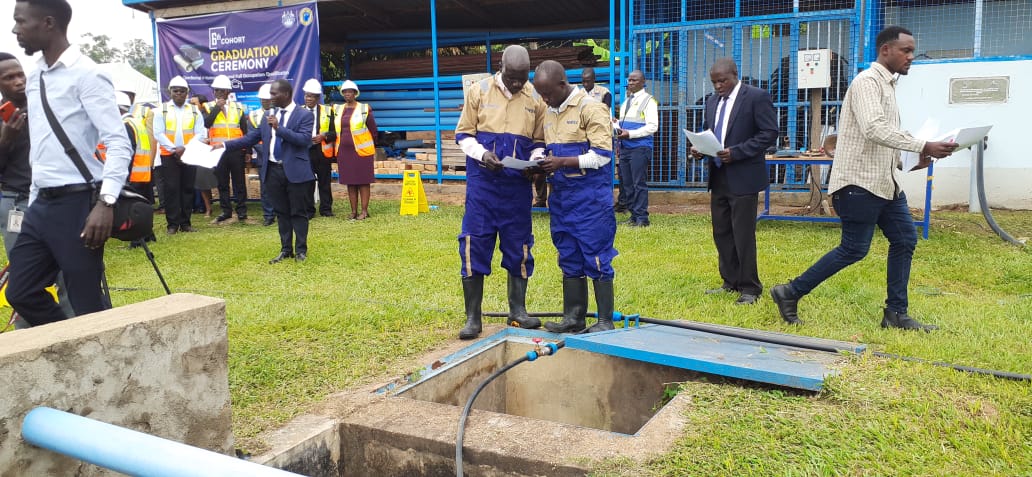
A total of 259 staff members of the National Water and Sewerage Corporation (NWSC) have graduated after completing training under the Practically Acquired Skills (PAS) programme at the corporation’s Vocational Skills Development Facility (VSDF) in Ggaba, Kampala.
The graduates completed specialised training in industrial plumbing, water treatment, electromechanical systems, water quality control, faecal sludge management, and customer advisory services.
The graduation ceremony was presided over by Allen Kagina, Chairperson of the Technical and Vocational Education and Training (TVET) Council, who commended NWSC for prioritising skills development and workforce empowerment.
Speaking at the event, NWSC Senior Director for Business and Scientific Services, Dr. Rose Kagwa, said the graduation aligns with the corporation’s Three-Year Corporate Plan (2024–2027), which prioritises learning and capacity development as key drivers of operational efficiency, service reliability and institutional sustainability.
Dr. Kagwa said NWSC treats training as a strategic function directly linked to measurable improvements in service delivery.
She noted that the strengthened Training and Capacity Development function under the Business and Scientific Services Division has already delivered tangible results, including improved water quality compliance through enhanced laboratory capacity and data-driven monitoring, as well as reduced system losses due to improved staff competencies.
“The VSDF remains central to this transformation by providing hands-on, demand-driven training that equips staff not only with qualifications but also with practical competence, responsiveness and a performance-oriented mindset,” she said.
She urged graduates to apply the skills acquired to improve performance, enhance innovation and deliver better services to customers.
“The sector is evolving rapidly due to technology, climate pressures and rising service demands. The knowledge and skills you have gained must now translate into meaningful impact within the organisation and the communities we serve,” she added.
Uganda Business and Technical Examinations Board (UBTEB) Executive Secretary Onesmas Oyesigye commended NWSC management for investing in staff capacity building and practical skills development.
“The certification of workers’ practically acquired skills and occupational qualifications will go a long way in enhancing professionalism within the NWSC service delivery system,” he said.
He encouraged more organisations to seek accreditation as assessment centres for continuous professional development, noting that many skilled Ugandans in the informal sector lack formal certification despite years of hands-on experience.
“We call upon all Ugandans, especially those in the informal sector, to take advantage of opportunities provided through practical skills certification,” he said.
NWSC Managing Director Engineer Dr. Silver Mugisha described the graduation as a demonstration of the corporation’s commitment to strengthening internal capacity through competency-based training.
“At NWSC, we believe our employees are our greatest asset. Investments in infrastructure must go hand in hand with investments in human capital,” he said.
Dr. Mugisha said the PAS programme continues to equip staff with practical skills that improve operational efficiency, service reliability and customer satisfaction.
He noted that the sixth cohort of graduates adds to a growing pool of skilled professionals prepared to address challenges in the evolving water and sanitation sector.
He urged graduates to use their skills to improve efficiency, reduce water losses, enhance response times and deliver quality services to customers.
Allen Kagina, speaking at the ceremony, said Uganda is undergoing reforms aimed at equipping citizens with practical skills to promote self-reliance and national development.
She emphasised that while education provides knowledge, practical skills empower people economically and help sustain livelihoods.
Kagina encouraged Ugandans, regardless of formal education level, to acquire at least one practical skill to support both personal and national development.
She also called for stronger collaboration between institutions and industries to build a credible, industry-ready workforce capable of driving national growth.
