

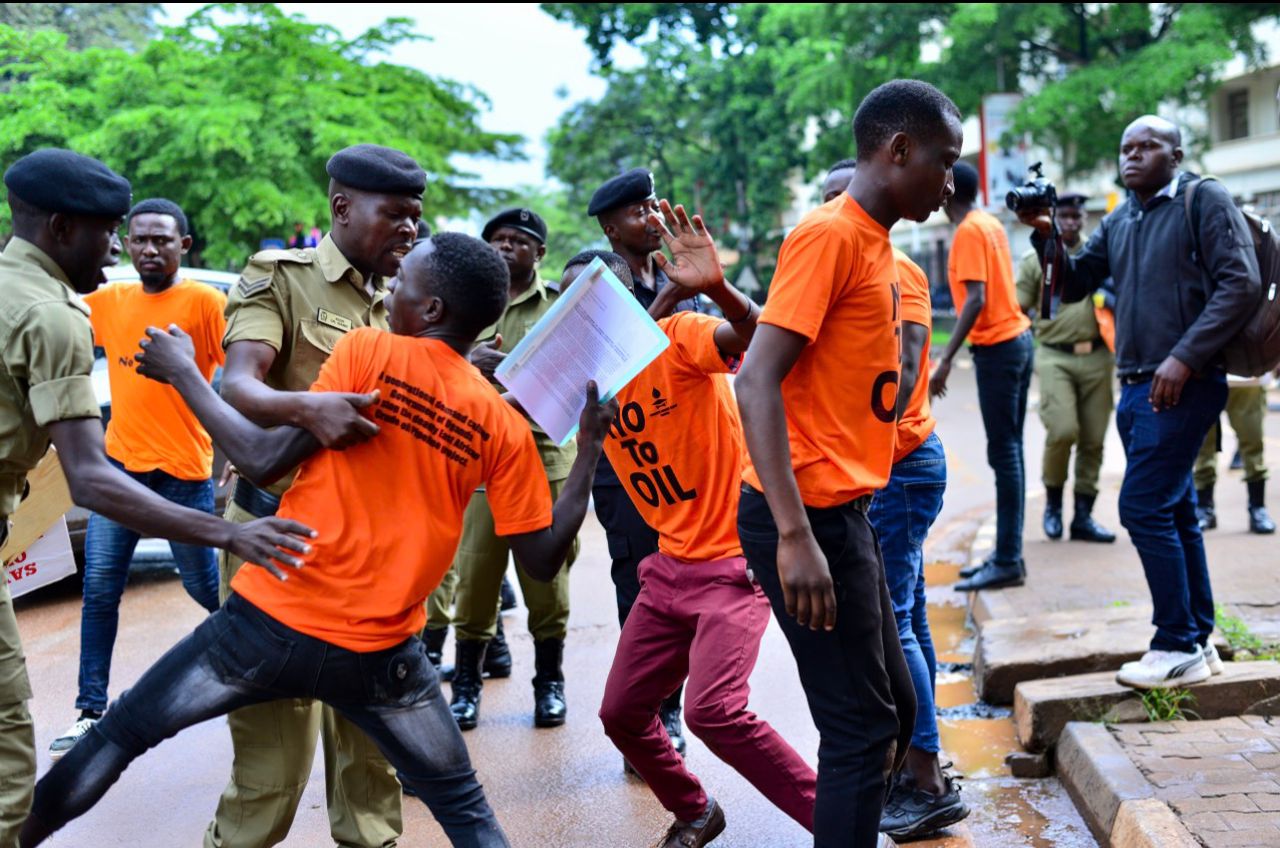
The High Court at Kampala Civil Division has awarded climate and human rights activists Shs10 million in damages after finding that their detention beyond the constitutional 48-hour limit during protests against the East African Crude Oil Pipeline (EACOP) project was unlawful.
The judgment was delivered on April 27 by acting judge Isaac Bonny Teko, who partly upheld the application filed by the activists linked to Rooted in Resistance against senior police officers and the Attorney General.
The case stemmed from events of November 24, 2023, when the applicants were arrested near Parliament while attempting to deliver a petition opposing the oil pipeline project.
Court documents show that the activists were later held in custody and produced in court on November 28, 2023, exceeding the constitutional requirement that suspects be presented before court within 48 hours.
The applicants alleged that during the arrest they were violently handled, humiliated, and detained incommunicado, claiming violations of several constitutional rights.
They relied on Articles 23, 24, 28, 29, and 44 of the Constitution, arguing that their liberty, freedom of expression, and protection from torture were infringed.
The respondents, including police officers and the Attorney General, defended the arrest, stating that the group had disrupted traffic and created public disorder near Parliament. They maintained that the arrest and detention were lawful and necessary for maintaining public order.
In his ruling, Justice Teko found that the detention of the activists beyond 48 hours without being brought to court was unconstitutional.
“The Constitution speaks in hours, not working days,” he noted, emphasizing strict compliance with Article 23 on personal liberty.
However, the court dismissed allegations of torture and cruel, inhuman and degrading treatment, stating that the applicants failed to provide sufficient medical or documentary evidence to support their claims.
The judge also declined to issue broad declarations on the legality of the protest, noting that evidence did not fully establish that the demonstration remained peaceful throughout.
On remedies, the court awarded Shs10 million in general damages for unlawful detention, significantly lower than the Shs200 million the applicants had sought.
The activists had also sought Shs100 million each in exemplary damages and asked the court to declare the involved officers unfit for public office, but these requests were rejected.
The court further ordered costs at 50 percent in favour of the applicants, noting they had only partially succeeded in the case.
Reacting to the ruling, lawyer Peter Arinaitwe welcomed the recognition of unlawful detention but questioned the court’s approach to proving torture.
“The Court watered down the elements of proof of torture to only documentary evidence which undermines the spirit of the law against torture,” he said.
“The Court went soft on the responsible police officers instead of holding them liable and penalizing them, which promotes impunity,” he added.
Despite his criticism, Arinaitwe welcomed the recognition of unlawful detention, saying it offers hope for victims of human rights violations and sets a precedent for police accountability.
