

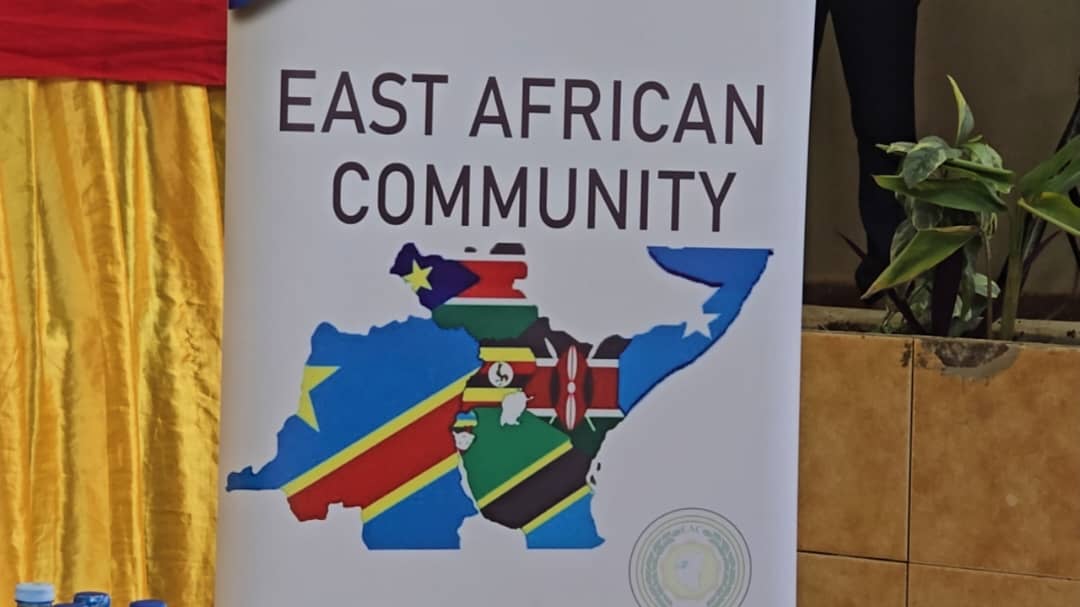
Efforts to popularise the East African Community (EAC) agenda in Mbale have exposed a widening gap between policy promises and lived realities, as local stakeholders expressed reactions ranging from cautious optimism to deep skepticism.
During a stakeholder engagement convened by the State Minister for East African Affairs, James Magode Ikuya, local leaders, traders, and farmers welcomed the idea of regional integration but questioned its practical implementation under the EAC framework.
The EAC is an intergovernmental bloc comprising eight partner states: the Democratic Republic of Congo, Somalia, and the republics of Burundi, Kenya, Rwanda, South Sudan, Uganda, and Tanzania.
Its strategic priorities for 2022–2026 focus on deepening regional integration through the implementation of the Single Customs Territory, strengthening commitments under the Common Market Protocol, and advancing plans for a single currency.
The bloc also aims to enhance peace, security, governance, infrastructure development, and public awareness, guided by key pillars including the Customs Union, Common Market, Monetary Union, and ultimately a Political Federation.
The dialogue—part of a broader government campaign to localise the integration agenda—was intended to empower grassroots actors to tap into cross-border trade opportunities. However, rather than a straightforward endorsement, the meeting evolved into a candid interrogation of the integration process.
At the centre of the discussion was a key contradiction: if the EAC Common Market guarantees free movement of goods, why do traders still face tariffs, restrictions, and enforcement crackdowns?
Participants questioned why agencies such as the Uganda Revenue Authority (URA) and security forces continue to pursue smugglers while integration is framed as enabling seamless trade. To many, enforcement actions blur the line between regulated and prohibited trade, creating uncertainty about what integration actually permits.
A URA official attempted to clarify that not all goods are tariff-exempt, noting that only selected products—particularly agricultural commodities—qualify for preferential treatment. However, this explanation did little to ease concerns.
Traders cited real-life experiences, including restrictions on commodities such as rice from Tanzania, arguing that policy implementation appears inconsistent and, at times, selective.
Beyond regulatory challenges, participants highlighted economic imbalances within the regional market. Some questioned why goods manufactured in Uganda are often more expensive than similar products from Kenya, raising fears that integration could disadvantage local industries.
At the same time, farmers pointed to clear benefits. Kenyan traders, they said, often offer better prices for produce, providing an alternative to what they described as exploitative local middlemen.
“Avocado farmers are benefiting significantly from the influx of Kenyan traders who buy directly from farms. Our local middlemen have been underpaying us,” one participant said.
However, this advantage has created new tensions. While farmers welcome cross-border buyers, some Ugandan traders feel undercut by foreign competition. The result is a fragmented response, where one group’s opportunity becomes another’s threat.
Concerns over fairness also emerged, particularly regarding treatment across borders. While Kenyan traders reportedly access Ugandan markets with relative ease, participants claimed that Ugandan traders face restrictions and hostility when operating in Kenya. This perceived lack of reciprocity continues to undermine confidence in the integration process.
Minister Magode emphasized that regional integration must go beyond treaties and be embraced by citizens.
“Heads of state may sign agreements, but it is the people of East Africa who must actively participate in building that unity,” he said.
He also highlighted the promotion of Kiswahili as a unifying language to bridge communication gaps across the region.
Meanwhile, Mbale Resident District Commissioner Stanley Bayole warned that internal divisions within Uganda—particularly tribalism—could weaken the country’s ability to benefit from regional opportunities.
“If we still discriminate among ourselves locally, how will we manage to integrate with Kenyans, South Sudanese, or Congolese?” Bayole asked.
In response to concerns raised, Minister Magode acknowledged that integration is an ongoing process shaped by negotiation, policy refinement, and political will.
However, discussions in Mbale suggest that for many at the grassroots, integration is judged less by treaties and more by everyday experiences—border checks, pricing disparities, and access to markets.
The dialogue highlights a critical challenge for the EAC: translating high-level commitments into consistent, predictable, and fair practices on the ground.
Until that gap is addressed, regional integration risks remaining an abstract ideal—embraced in principle but contested in practice.
For now, voices from Mbale underscore a simple reality: regional unity cannot merely be declared—it must be experienced.
