

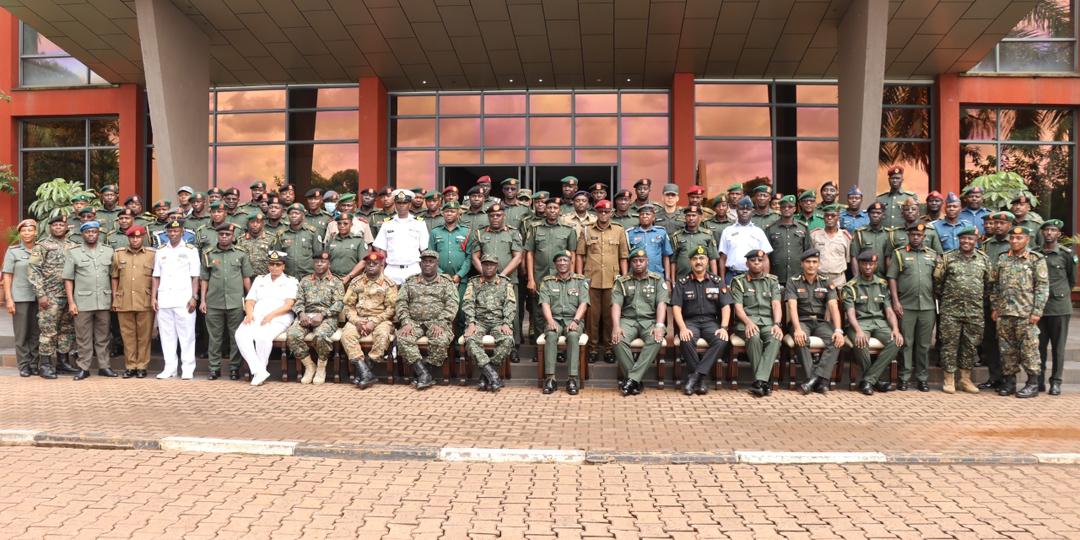
The Uganda Peoples’ Defence Forces (UPDF) has reinforced its commitment to professional military education and regional security cooperation by hosting a delegation from the Senior Command and Staff College, Kimaka, at the Defence Intelligence and Security (DIS) Headquarters in Mbuya.
The delegation, comprising directing staff and student officers from Intake 21/25–26, participated in a high-level lecture designed to broaden their understanding of military structures and the UPDF’s strategic role in fostering peace and stability across the region.
Delivered under the theme “Organisation and Functions of Services, Joint Staff Structure, Directorates, and UPDF Enhancement Towards Regional Peace and Security,” the session focused on unpacking the force’s institutional framework, command systems, and evolving operational priorities.
Presiding on behalf of the Chief of Joint Staff, the Joint Staff Human Resource Management, Major General James Kinalwa, said the UPDF Establishment (2021) serves as a cornerstone for building a modern, professional, and accountable military. He noted that a clear understanding of organisational structures and human resource systems is essential for enhancing operational effectiveness.
Kinalwa further praised the leadership of the Senior Command and Staff College, Kimaka, for integrating such engagements into their training programme, describing them as critical in preparing officers for complex command and staff responsibilities.
The Deputy Commandant, Senior Staff and Command College, Brigadier General Elvis Byamukama, highlighted the multinational composition of the course, with participants drawn from Uganda, Egypt, Kenya, Tanzania, South Africa, South Sudan, Rwanda, and Burundi. He pointed out that this diversity enriches professional exchange and strengthens regional military collaboration.
Speaking on behalf of the Chief of Defence Intelligence and Security, Lt Col Martin Nsengiyumva drew attention to Uganda’s economic and geographic realities as a landlocked country dependent on secure regional trade routes. He stressed that maintaining national security requires a responsive and capable defence force supported by strong intelligence systems.
Lt Col Nsengiyumva also underscored the importance of collective security efforts, noting that cross-border threats continue to challenge regional stability.
Militant groups such as Al-Shabaab in Somalia and the Allied Democratic Forces (ADF) operating in eastern Democratic Republic of Congo remain significant concerns, contributing to ongoing instability and the displacement of more than two million refugees into Uganda.
On behalf of the students, Maj Brenda Ninsiima expressed appreciation to the UPDF leadership for hosting the lecture, describing it as timely and insightful.
“The lessons we have learnt will be invaluable in our future assignments,” she said.
The lecture was attended by senior officers, including the Chief of Staff Land Force, Brig Gen Chris Bagonza, and the Chief of Staff Reserve Force, Brig Gen Mwanje Ssekiranda, among others.
