

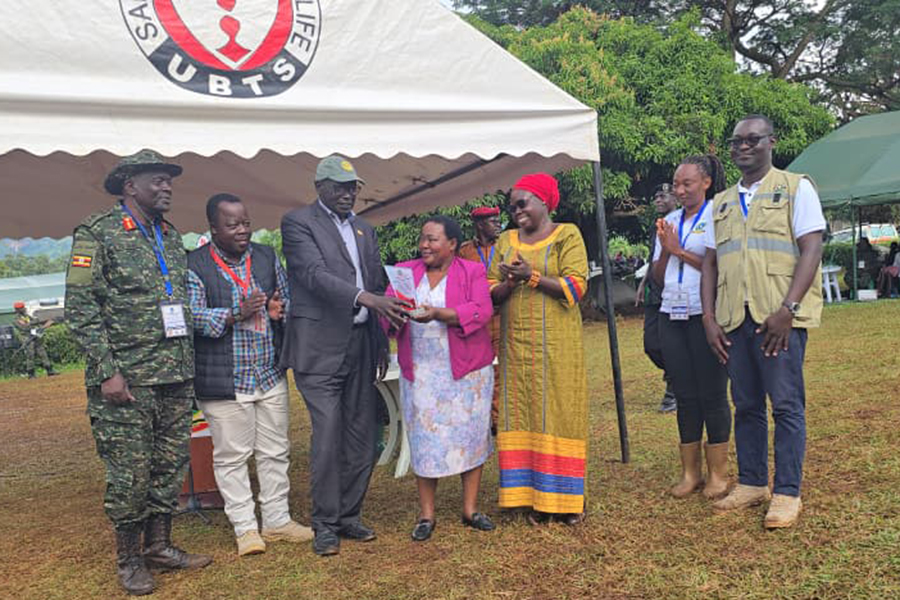
Prime Minister Robinah Nabbanja has proposed a new approach to disaster resettlement, recommending that government empowers affected families to purchase their own land instead of relying solely on state-led acquisition of large land parcels, which she said has been slow and increasingly difficult.
Nabbanja made the remarks in Bulambuli District where she presided over the closure of a two-week disaster response field training exercise dubbed “Okoa Maisha 26”, coordinated by the Uganda Peoples’ Defence Forces (UPDF) Rapid Deployment Capability under the theme of strengthening multi-sectoral resilience and locally-led disaster response through integrated leadership and command.
The exercise brought together participants from the Office of the Prime Minister, UPDF, local governments, and humanitarian agencies, including the Uganda Red Cross Society, to test coordination and response capacity in simulated disaster scenarios.
The Prime Minister observed a field simulation exercise in which teams demonstrated emergency response skills in a constructed disaster environment before proceeding to the National Agriculture Research Organisation (NARO) offices in Bulegeni Sub-county, where she later addressed stakeholders.
She emphasised that effective disaster management requires coordinated action across government institutions, security agencies, development partners, and local communities, warning that fragmented responses weaken national resilience.
“Disaster management requires a coordinated, multi-sectoral approach. We must strengthen collaboration between government institutions, security forces, development partners and communities,” Nabbanja said.
She reaffirmed government’s commitment to strengthening early warning systems, improving preparedness, and supporting affected communities through both immediate relief and long-term recovery interventions.
“The government will continue to invest in early warning systems and stronger district disaster management committees. Uganda is advancing risk planning so that development gains are not reversed by disasters,” she added.
Nabbanja noted that while government has been implementing a structured resettlement programme—under which each affected household is allocated two acres of land and Shs10 million—implementation has faced major setbacks due to difficulties in securing suitable land.
She explained that government’s initial plan to resettle communities collectively in designated areas has been constrained by legal disputes and competing land ownership claims.
“We want to settle people in the same area so that we can provide essential social services such as water, electricity, schools, health centres and roads. But we are finding it difficult because in most of these areas the land is encumbered with pending court disputes,” she said.
As a result, Nabbanja revealed that she has sought presidential guidance to allow the Office of the Prime Minister to shift towards a more flexible approach where affected households are supported to purchase their own land.
“I am currently requesting the President to allow the Office of the Prime Minister to give support to the affected people to buy land themselves,” she said.
Under the proposed arrangement, she explained, households would receive an initial payment at government valuation rates to enable them acquire at least two acres of land, followed by an additional Shs10 million upon confirmation of land purchase.
The Prime Minister said the proposed shift is intended to speed up resettlement, reduce bureaucratic delays, and prevent further loss of life in disaster-prone regions.
Bulambuli District has repeatedly experienced deadly landslides, with dozens of people buried in a major incident in December 2024, underscoring the urgency of durable resettlement solutions for vulnerable communities.
State Minister for Defence and Veteran Affairs Huda Abasoni Oleru emphasised the importance of coordination and joint preparedness in emergency response, noting that effective disaster management depends on seamless cooperation between civilian and security agencies.
The UPDF also reiterated its commitment to supporting rapid disaster response operations through coordinated deployment and logistical support under national emergency frameworks.
