

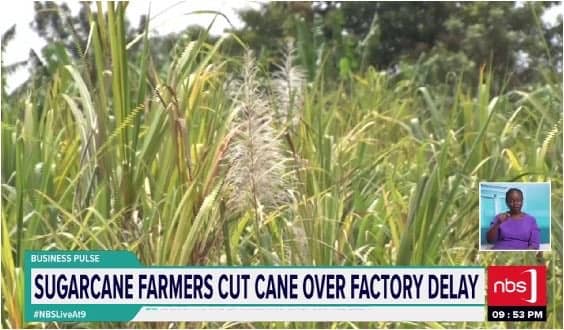
Farmers in Namayingo District are facing a severe crisis as prolonged delays in granting CN Sugar Factory an operational license threaten their livelihoods. With over-mature sugarcane drying up in the fields, many out-growers have begun cutting down their crops while pleading for urgent government intervention.
The plight of the farmers—many of whom signed contracts with CN Sugar Factory in 2024—has worsened due to the factory’s failure to secure a license to commence operations. Although the factory was expected to process their cane, the licensing delay has left farmers stranded and unable to sell to other millers because of restrictive contractual agreements.
Musa Osinya, a farmer from Buyinja, said he planted more than 15 acres of sugarcane in anticipation of supplying CN Sugar and encouraged his five siblings to do the same. However, the continued delay has disrupted their plans.
“We had high hopes, but now our crops are over-mature and drying up in the fields,” Osinya said, expressing the frustration shared by many farmers who feel abandoned by the project they invested in.
Rev. Henry Ouma, a resident of Kifuyo, echoed similar concerns, highlighting the high cost of transporting sugarcane to alternative mills.
“Farmers are charged between Shs 800,000 and Shs 900,000 by truck drivers to transport sugarcane to mills in Bugiri, Mayuge, or Jinja. With such high transport costs, it is nearly impossible to break even,” Ouma explained.
Twalik Isabirye, Chairperson of the Sugarcane Out-growers in Namayingo, said farmers are unable to sell their cane elsewhere due to a Memorandum of Understanding (MoU) signed with CN Sugar. The agreement binds them to supply exclusively to the factory, which had provided incentives such as fertilizers and seedlings.
“We cannot sell our cane to other mills because we are bound by the agreement, and CN Sugar has supported us with inputs,” Isabirye said.
The financial strain is mounting. Some farmers leased land for six years, but with two years already lost without any sales, debts are accumulating.
“We hired land for six years, but two years have already passed and we are still waiting to sell our cane,” Isabirye lamented.
The growing frustration has prompted appeals to President Museveni for swift intervention. Farmers argue that their strong electoral support for the President in the recent elections warrants urgent government action.
“We supported Museveni overwhelmingly in the just-concluded elections, and we are now asking him to intervene and ensure CN Sugar begins operations before it is too late,” a group of out-growers said.
Farmers also noted that CN Sugar’s operations could generate much-needed employment for local youth, many of whom previously relied on fishing for their livelihoods.
“Our youth depended on the lake, but due to the crackdown on illegal fishing, many lost their jobs. CN Sugar was their only hope,” they added.
The matter was recently discussed during a meeting with Resident District Commissioner Eva Kwesiga at Kifuyo Village, where farmers presented their concerns.
RDC Kwesiga assured them that the issue had been forwarded to the Sugar Council for review in line with the Sugar Act. She pledged to lead a delegation to petition the Prime Minister if no swift action is taken.
“If the Sugar Council does not act, we will go directly to the Prime Minister’s office to seek intervention,” Kwesiga said.
Isa Budhugo, the Busoga region’s representative on the Sugar Council, confirmed that the council is aware of the situation and is taking steps to address it.
“We inspected CN Sugar on January 29 to assess whether the factory meets the requirements for licensing,” Budhugo said, adding that the council is scheduled to meet on February 16 to deliberate on the findings and determine the next course of action.
Under the Sugar Act, a new sugar factory must have at least 500 hectares of sugarcane, valid land titles, and formal contracts with out-growers to qualify for a license.
CN Sugar’s proximity to Bugiri Sugar Factory has sparked concerns among some local millers, who argue that it could trigger unhealthy competition for limited cane supply. Although the Sugar Act requires a minimum distance of 25 kilometers between factories, CN Sugar is located 37 kilometers from Bugiri Sugar Factory. Despite objections, Namayingo out-growers insist that the factory’s opening is critical to safeguarding their livelihoods.
Despite the mounting challenges, farmers remain hopeful that the government will intervene before their sugarcane withers completely. They maintain that operationalizing CN Sugar would not only save their crops but also stimulate economic growth and create employment opportunities in the district.
For now, the fate of their harvests—and their livelihoods—rests with the Sugar Council as it deliberates on the factory’s licensing approval.
