

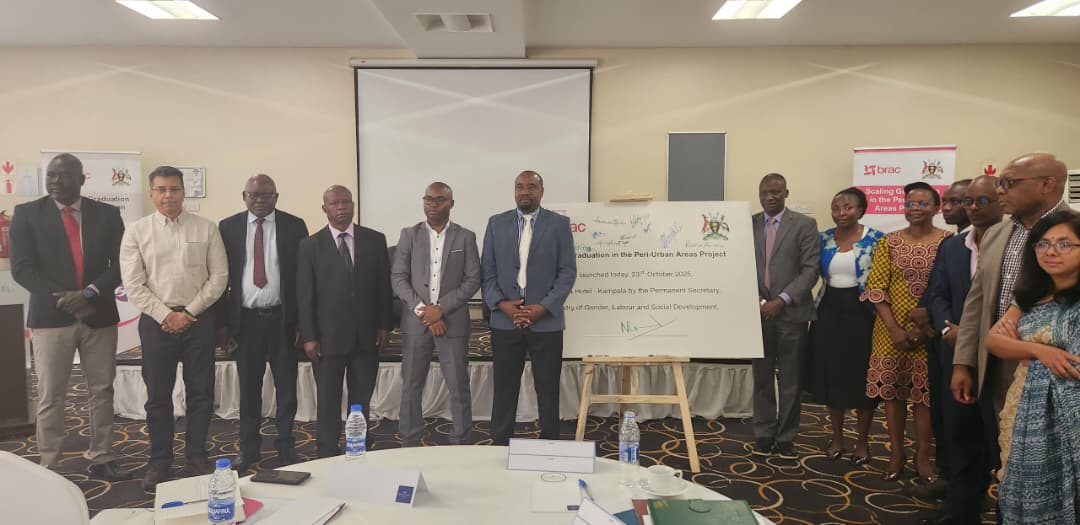
BRAC Uganda has launched a shs17.4 billion (USD 5 million) project aimed at transforming the lives of 3,300 ultra-poor households in the Busoga sub-region by helping them graduate from extreme poverty through asset transfer, skilling, and financial inclusion.
The Scaling Graduation in Peri-Urban Areas Project, a 27-month initiative, will be implemented in the districts of Luuka, Iganga, and Bugiri.
It seeks to promote sustainable socio-economic development by empowering women-headed households and strengthening family resilience.
Speaking during the launch, BRAC Uganda Country Director, Speaking Atuhairwe, said the project builds on BRAC’s five decades of experience in poverty alleviation through its globally recognized Graduation model.
“We are here today to officially launch a 27-month project that enables people to graduate out of poverty,” Atuhaire said.
“It is a well-tested model that empowers people through mindset change, skills, assets, and access to financial services so they can move out of poverty sustainably.”
Atuhairwe explained that the intervention focuses on entire households rather than individuals, with special attention given to women as entry points for change.
“Our entry point is the woman in the household, but we work with their children, spouses, and the wider community to ensure everyone participates in transforming the home,” she added.
“We also provide short-term consumption support before giving assets to help families stabilize and make the most of the assistance.”
Project Manager Joseph Kabanda said the program targets peri-urban populations who are often overlooked by traditional poverty alleviation models.
“The project will target the most vulnerable out-of-work households, especially those headed by women, living in peri-urban areas and major trading centres,” Kabanda said. “We’ll use BRAC’s Graduation model built around four pillars — social protection, social empowerment, financial inclusion, and livelihood promotion.”
He noted that Busoga was selected because of its persistently high poverty levels, adding that the model will be adapted to the region’s unique economic and social context.
“Busoga remains one of the regions with the highest poverty rates in Uganda,” Kabanda explained. “We’ll begin with a market assessment to identify viable economic ventures, followed by skilling, daily coaching, and linkage to financial institutions, including BRAC Bank.”
Kabanda added that the program aims to ensure that by the end of two years, participants have food security, savings, and at least three productive assets, while improving hygiene and sanitation at the household level.
Representing the Ministry of Gender, Labour and Social Development, Commissioner Bernard Mujuni—on behalf of Permanent Secretary Aggrey Kibenge, praised BRAC for championing a comprehensive and inclusive model aligned with Uganda’s national development priorities.
“This project provides holistic, context-specific, climate-sensitive, and time-bound interventions that enable households to transition toward sustainable livelihoods, resilience, and social inclusion,” Mujuni said.
He emphasized that the initiative complements government programs such as the Parish Development Model (PDM), Women Entrepreneurship Program, and Youth Livelihood Program.
“If PDM adopted BRAC’s approach, the impact would be far greater,” Mujuni remarked. “This model challenges us to rethink how we deliver poverty reduction programs it’s inclusive, evidence-based, and results-oriented.”
The project, he said, aligns with Uganda’s National Development Plan IV (NDP IV) and supports global goals such as SDG 1 (No Poverty), SDG 2 (Zero Hunger), and SDG 8 (Decent Work and Economic Growth).
“We commend BRAC Uganda for implementing a model that not only meets the immediate needs of ultra-poor households but also builds long-term resilience and dignity,” Mujuni concluded.
“The ministry pledges full support to ensure its success and possible scale-up across the country.”
Anne Mutta, BRAC’s Regional Director, described poverty as “deeply dehumanizing,” sharing personal experiences that illustrate its psychological toll.
“Poverty removes human dignity,” she said. “It reduces you to invisibility. One woman in our Bangladesh program told me her biggest change after graduation was that she now gets invited to weddings. That simple statement shows how exclusion runs deep.”
Mutta emphasized that poor people are not voiceles, they are simply unheard.
“People living in poverty know what they need; we just need to listen,” she said.
She hailed the project noting that it gives them an opportunity to hear their voices and act.
She urged policymakers and development partners to use the project to rethink how they measure impact and engage communities.
“Statistics are important, but behind every number is a person,” she said.
“Ultimately, development is about giving people dignity and a seat at the table or even creating bigger tables so that everyone can belong.”
The Scaling Graduation in Peri-Urban Areas Project was officially launched at Protea Hotel in Kampala, bringing together key stakeholders from government ministries, the private sector, and Resident District Commissioners (RDCs) from the targeted districts.
The stakeholders warmly welcomed the initiative, noting that it will play a crucial role in helping vulnerable households in Busoga sub-region recover from extreme poverty and rebuild their livelihoods through sustainable socio-economic development.
