

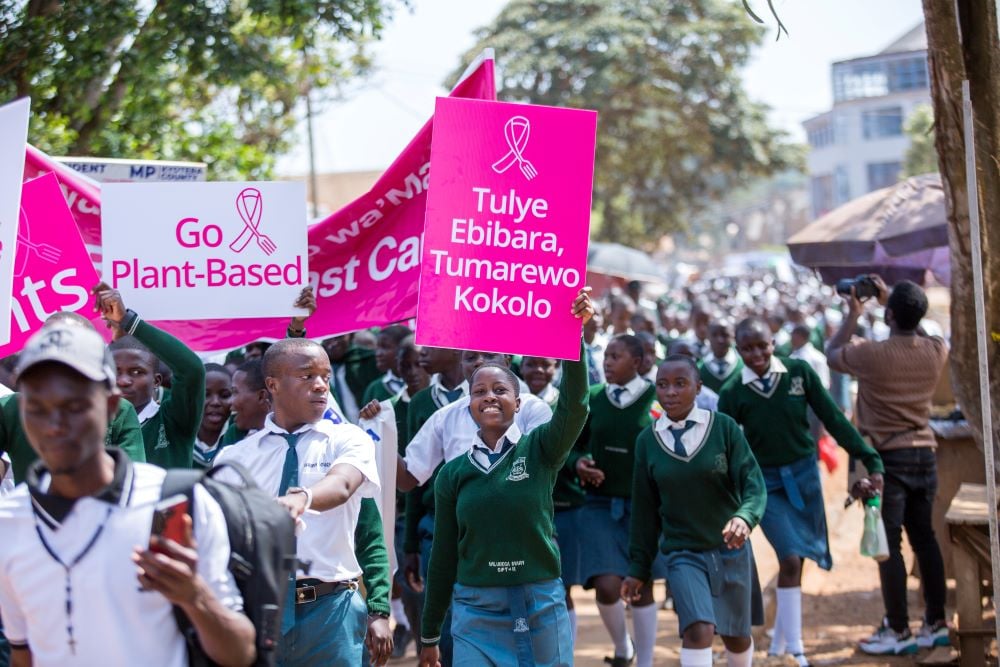
More than 1,000 women, schoolgirls, health workers, and community leaders gathered in the streets of Kyotera and at the Kalisizo playground today for a powerful Breast Cancer Awareness Rally organized by the Physicians Committee for Responsible Medicine (PCRM).
The event delivered a clear and urgent message: diet and lifestyle choices can save lives.
The Uganda rally—one of many taking place globally as October’s Breast Cancer Awareness Month approaches—highlighted how a whole food, plant-based diet can play a key role in preventing breast cancer.
In Uganda, breast cancer incidence stands at 21.3 per 100,000 women, with a mortality rate of 10.3 per 100,000, largely due to late-stage diagnosis. According to a 2020 report by the Fred Hutch Cancer Center, up to 89% of women present at Stage III or IV, significantly reducing their chances of survival.
Breast cancer is currently the third most common cancer among Ugandan women, after cervical cancer and Kaposi’s sarcoma. Organizers emphasized that while October brings attention to breast cancer, prevention must be a year-round commitment.
“While October turns the world pink, our commitment does not fade when the month ends,” said Mark, PCRM’s representative in Uganda. “We are here to show that no one is powerless. The science is clear—shifting to a plant-based diet is a shift toward prevention and power. We can fight breast cancer with our forks.”
Among those who spoke was Juliet Namagembe, a mother of three from Kyotera, who shared how her dietary changes after a breast cancer diagnosis helped her regain strength and hope.
“When I was told I had early-stage breast cancer, I thought it was the end,” Namagembe said. “But then I learned about food as medicine. I began eating more vegetables and traditional plant foods my grandmother used to grow. I felt stronger. I felt in control. Today, I share my story because I want other women to know: what you eat matters.”
Her testimony embodied the theme of the rally—empowerment through everyday choices.
According to the Uganda Cancer Institute, breast cancer is the leading cancer among Ugandan women, with approximately 4 in every 100 women diagnosed in their lifetime. Most cases are detected late, highlighting the importance of prevention and early awareness.
Dr. Joseph Lule, a consultant surgeon from Mulago Hospital, emphasized that a community-led approach is essential. “The rising number of breast cancer cases in Uganda, particularly among younger women, calls for grassroots action,” he said. “Events like this rally demystify cancer and equip families with practical, cost-effective prevention steps—like eating more local vegetables, fruits, and grains.”
Local leadership added its voice to the initiative. John Paul Mpalanyi, Member of Parliament for Kyotera District, praised the event’s impact and pledged continued support for community health education.
“Breast cancer is not just a health issue; it is a family and community issue,” Mpalanyi said. “What we’ve seen here in Kyotera today proves that awareness begins with the people. I thank PCRM for this initiative and will continue advocating for programs that bring preventive health information to schools, households, and communities. Prevention is always better—and cheaper—than cure.”
From Naperville, Illinois, to Phuket, Thailand, and now Kyotera, Uganda, communities are rallying under PCRM’s global Let’s Beat Breast Cancer campaign. The campaign highlights research showing that nearly half of all breast cancer cases could be prevented through diet and lifestyle—yet public awareness remains dangerously low.
A recent PCRM survey in the U.S. found that only 28% of women were aware of the connection between diet and breast cancer. In Uganda, awareness is even lower, making educational efforts like Kyotera’s rally critically important.
The rally’s key message encouraged four evidence-based strategies to reduce breast cancer risk: adopting a whole food, plant-based diet; engaging in regular physical activity; limiting alcohol consumption; and maintaining a healthy weight.
With enthusiastic support from political leaders, women’s organizations, youth advocates, and healthcare professionals, the rally sparked meaningful conversations in both English and Luganda. The chant of “Fight Cancer with Food!” rang out across Kyotera, inspiring a people-driven movement for change.
