

The Great War changed the world as empires collapsed, new nations were created and powerful political figures emerged, going on to set the agenda for a new order.
Here are brief profiles of five of the leading figures of World War I and its aftermath.
- US: Thomas Woodrow Wilson -
Democratic president Thomas Woodrow Wilson (1856-1924) won re-election in 1916 on a campaign of keeping the United States out of the conflict in Europe, even though Washington was helping finance the Allied war effort.
But this changed after German submarines sank US ships crossing the Atlantic and he sent the first troops in April 1917.
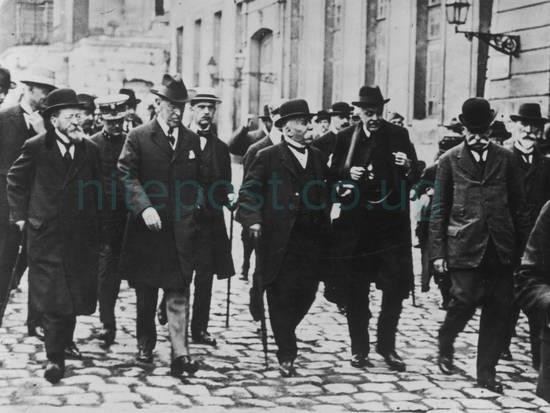
Wilson was a key player in the post-war negotiations in Paris in 1919 and the resulting Versailles Treaty was based on his "Fourteen Points" for peace.
They included the creation of a body that became the League of Nations, the precursor to today's United Nations, and provisions on sovereignty and open diplomacy.
He was awarded the Nobel Peace Prize in 1920.
- France: Georges Clemenceau -
Nicknamed "The Tiger", the hardline Republican Georges Clemenceau (1841-1929) was appointed French prime minister in 1917, when Allied victory seemed uncertain.
With a fierce resolve for victory, he centralised and stimulated the war effort while gaining strong popular backing in part because of his regular visits to the front line.
Also one of the architects of the Versailles Treaty, he was less open than his US and British allies to compromise with the Germans, insisting on punishing terms and vowing "Germany will pay".
- Britain: David Lloyd George -
David Lloyd George (1863-1945) was a Liberal party pacificist who converted to rally behind the war, first as minister of munitions in 1915 and then as war minister and a galvanising prime minister in 1916.
Dynamic and determined, he boosted public morale and brought new energy and organisation, creating the civil infrastructure to support the troops and unifying the Allied military command in 1917.
Lloyd George represented Britain at the Paris Peace Conference and remained prime minister until 1922.
- Russia: Vladimir Lenin -
Marxist Bolshevik revolutionary Vladimir Ilich Ulyanov (1870-1924) lived mostly abroad during the war, which he opposed as "imperialist".
He returned to his country in February 1917, with the help of the Germans who hoped he would help weaken their Russian enemy, and convinced fellow Bolsheviks to revolt in October 1917.
A supporter of an immediate peace with Germany, he was the driving force in Russia for the Brest-Litovsk Treaty (1918) which ended the fighting at the cost of Moscow ceding massive parts of its territory and more than 30 percent of its population.
- Turkey: Mustapha Kemal Ataturk -
A colonel and then general in the Ottoman army, Mustapha Kemal Ataturk (1881-1938) led the victory against the Allies in the Gallipoli Campaign in 1915.
He then headed a nationalist movement that fiercely opposed the 1920 Treaty of Sevres between the Allies and the Ottoman empire and which led to the latter's dismantling.
As the Allies tried to carve up the empire, Ataturk commanded an army that reconquered Armenia and Kurdistan and drove the Greeks out of Asia Minor. He became president in 1923 and is considered the father of modern Turkey.
