

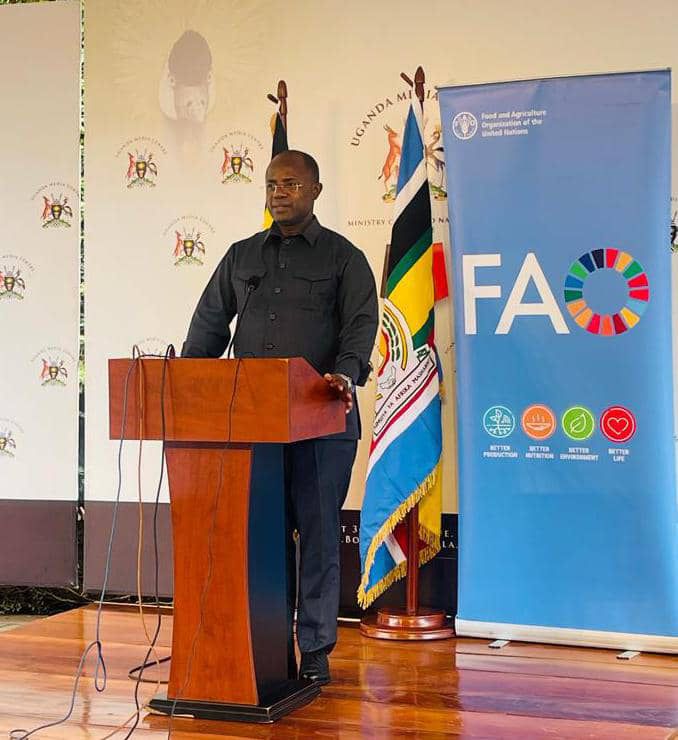
As Uganda prepares to mark the 44th World Food Day on October 16, 2024, the Minister of State for Agriculture, Fred Bwino Kyakulaga, outlined significant achievements in the nation’s agricultural sector while calling for continued efforts to address food insecurity, malnutrition, and the emerging threats posed by climate change.
World Food Day, observed globally, serves as a reminder of the importance of food security and the fundamental right to nutritious food.
This year’s theme, “Right to Food for a Better Life and a Better Future,” underscores the government's commitment to ensuring that all citizens, regardless of their social or economic background, have access to sufficient, safe, and nutritious food.
In his statement, Kyakulaga reflected on the considerable progress Uganda has made in its agricultural sector, which remains the backbone of the economy.
“Agriculture continues to play a pivotal role in the development of our nation. It is not only vital for food security but also for the livelihoods of a significant portion of our population,” he said.
According to the Minister, agriculture contributes about 24% of Uganda’s GDP and employs nearly 70% of the country’s workforce, making it central to the country’s economic health.
Kyakulaga acknowledged that much of this progress is due to the leadership of President Museveni and the government’s strategic interventions in agriculture over the years.
“With support from the government, we have promoted the use of improved seed varieties that are disease-resistant, ensuring higher yields and greater resilience to climate shocks. Key crops such as maize, beans, cassava, millet, and rice have all seen increased productivity,” he noted.
Kyalulanga also noted Uganda’s investment in irrigation and mechanisation. The development of irrigation schemes like Doho, Mubuku, and Agoro has enabled farmers to grow food year-round, reducing dependence on seasonal rainfall.
Kyakulaga emphasised that irrigation is a game-changer for Uganda’s agricultural future, particularly as climate change increasingly threatens predictable weather patterns.
“These investments have allowed us to ensure food security, even during prolonged dry spells. Our farmers are now able to produce food throughout the year,” he said.
In addition to irrigation, the government has focused on improving agricultural mechanisation. The establishment of mechanisation hubs across the country has provided farmers with access to modern tools that make farming more efficient and less labor-intensive.
“Mechanisation is empowering our farmers to improve their productivity, which ultimately enhances food security and the livelihoods of Ugandans,” Kyakulaga explained.
The Minister also emphasised the significant strides Uganda has made in the fisheries and aquaculture sectors. Fish, a crucial source of protein for many Ugandans, has become more affordable and accessible thanks to government interventions, such as the construction of fish landing sites and the promotion of sustainable aquaculture practices.
“We are committed to ensuring that every Ugandan has access to affordable fish, which is essential for their health,” Kyakulaga stated.
In the address kyakulanga also highlighted on the government’s efforts in post-harvest management and value addition. Reducing post-harvest losses has been a priority, and the establishment of agro-processing plants has enabled farmers to maximize the value of their produce.
Kyakulaga stressed that these initiatives contribute not only to food security but also to the creation of jobs and the growth of the rural economy.
Kyakulaga also acknowledged the significant role of agricultural research in improving food security. The National Agricultural Research Organisation (NARO), through institutions like the National Semi-Arid Resources Research Institute (NaSARRI), has been instrumental in developing climate-resilient crop varieties.
“NaSARRI’s work in breeding drought-resistant crops like millet and sorghum is crucial in enhancing food security, particularly in the semi-arid regions of our country,” he explained.
However, while Uganda has made commendable strides, Kyakulaga also addressed the challenges that still threaten food security. One of the most pressing issues is the impact of climate change, which has led to erratic weather patterns, prolonged droughts, and devastating floods in some regions.
The Minister called for increased investments in climate-smart agriculture and irrigation to mitigate these effects. “Climate change poses a serious threat to our agricultural systems, and we must continue to invest in sustainable farming practices to protect our food production systems,” he said.
Another challenge is the rising rates of malnutrition, particularly among vulnerable populations such as children and women.
Kyakulaga stressed that the government remains committed to addressing this issue through nutrition-sensitive agriculture and awareness campaigns.
He highlighted the work being done by NARO, which has released crop varieties with enhanced nutritional content, such as high-vitamin potatoes and beans. “We must focus not only on the quantity of food we produce but also on its nutritional value to ensure that our people lead healthy and productive lives,” Kyakulaga said.
As World Food Day approaches, the Minister called for a united national effort to ensure that food security becomes a reality for all Ugandans. He urged farmers to embrace modern agricultural practices, including climate-smart techniques and the adoption of improved seed varieties. He also appealed to the private sector to continue investing in agro-processing and value addition. “We need everyone—farmers, the private sector, development partners, civil society, and the public—to join hands and work together to ensure that every Ugandan has access to the food they need to live a healthy life,” Kyakulaga said.
In closing, the Minister expressed his gratitude to Uganda’s international partners, including the Food and Agriculture Organization (FAO), World Food Programme (WFP), International Fund for Agricultural Development (IFAD), and the European Union, for their continued support in strengthening Uganda’s food security. He also thanked them for their contributions to the national agenda of ensuring the right to food for every Ugandan.
The national World Food Day event will take place at NaSARRI in Serere District, an institution renowned for its agricultural research and innovation. It is a fitting venue, given its longstanding role in pioneering crop development for food security.
“We are building a better life today, so that future generations can enjoy a brighter, more secure future,” Minister Kyakulaga concluded, reaffirming the government’s commitment to achieving food security for all Ugandans.
