

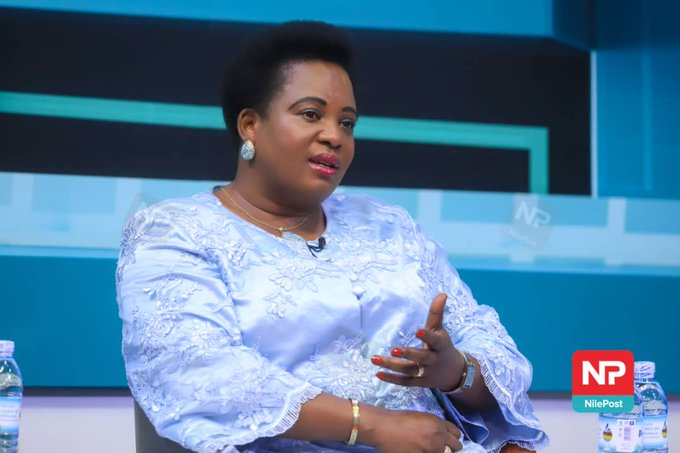
The Minister of Gender, Labour and Social Development Betty Amongi has said political transition in this country cannot happen without President Museveni's input.
Appearing on NBS television, Amongi asked all political parties to craft an agenda regarding transition for the discussion with president Museveni if they want to see the success of this initiative.
“We need a transition. This transition can't happen without President Museveni. Once you realize that, we will say ANT, DP, FDC, and NUP, can an agenda be crafted to discuss with President Museveni?” she queried.
Amongi stressed that if Ugandans want to see this country move forward in terms of transition, the issue of an engagement or discussion on the matter should be put at the centre stage.
“In 2016, when I was told by the people where I come from that I must support H.E Museveni, they said they were scared of messages coming from a certain section of the opposition that might lead us into another war. We don't want to go back to war,” she said.
Amongi said she needs the stability Museveni has created so as to continue discussing the transition, adding that on the side of democracy, after the election, people thought there would be instability, but there has been stability to a large extent.
Speaking in response, the FDC national chairman, Ambassador Wasswa Birigwa said this would have been a good idea but there is no levelled ground in Uganda as far as politics is concerned.
“Ugandans need change. We need to talk about how to achieve the transition of power, not what is happening between Museveni and his son. That is succession. They (NRM) are bankrupt as far as ideas are concerned. This country is stuck. To get out of this mud, we need to start a transition process,” he noted.
Birigwa also suggested that there is a need to write a new constitution because the current one is " dead" since everyone with power changes provisions it in with ease.
Last year, the DP president general, Nobert Mao signed a deal with the ruling National Resistance Movement (NRM) supremo, President Museveni that saw him appointed as minister of Justice and Constitutional Affairs .
Mao later claimed that the deal he had struck with Museveni allowed him to form a constitutional review commission that would lead to transition.
But three months after the deal was signed at State House Entebbe, the president came out to deny Mao’s claims on transition, insisting that the deal was simply to bring the opposition into the orbit of the NRM government.
Since independence, Uganda has never witnessed a peaceful transfer of presidential power.
Elections in Uganda are marred with violence, bribery, intimidation, and ballot stuffing.
Every five years, Ugandans go to the polls to elect their president and local representatives.
