

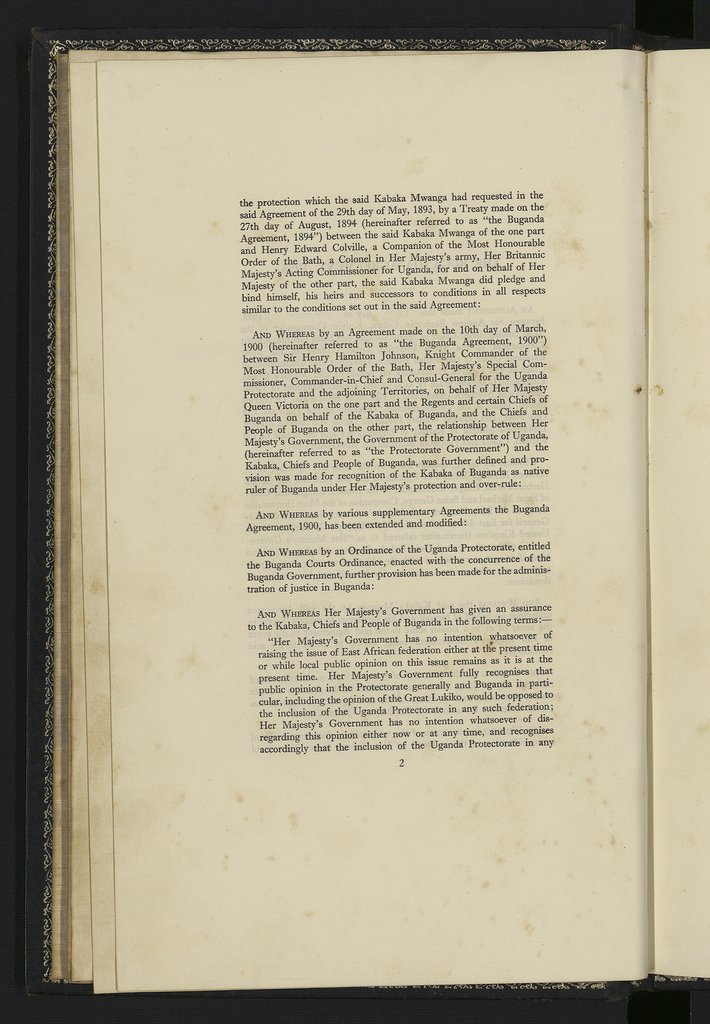
The 1900 Buganda Agreement which under article 3 put in place Buganda “as a province of equal rank with any other provinces into which the protectoral maybe divided”, was required in Article 4 to collect revenue.
The collected tax was to be merged in general revenue of the Uganda Protectorate as that of the other provinces of the Protectorate.
Under Article 20, the colonial protectorate government would, “no longer consider themselves bound by the terms” of the Buganda Agreement if within two years after the signing of the agreement, the allotted quota of taxes to be raised by Province of Buganda had not been raised in an amount equal to half of the imposed quota.
The continued recognition of the Kabaka and his chiefs therefore depended, on their ability to collect taxes.
It is obvious that the agreement reduced the Kabaka and his chiefs to mere owners of exclusive revenue collection rights for the colonialists.
The revenue collection rights was based on the mailo land giveaway accorded to Kabaka and his chiefs both official mailo and private mailo as defined in the Land Law of 1908 and the Buganda Agreement (Allotment and Survey) of 1913.
The mailo land ‘giveaway’ originally in the 1900 Agreement but later refined in the Land Law of 1908 and the Buganda Agreement (Allotment and Survey) of 1913, marked the end of Buganda Kingdom and turned its leaders into instruments of colonialism.
These chiefs did all the revenue collection work and spared the Colonialists the effort and expense of setting up a large administrative machinery.
This colonial policy while enriching the mailo land tax collector chiefs, it deprived bibanja holders of their land and also degraded their leaving standards, turning them into slaves in their own Country.
The bibanja holders felt the heavy burden of both deprivation of land and heavy taxation leading to their revolt by way of refusing to cultivate cash crops.
This deprived the mailo owners of their land rental tax (busulu) while the colonialists, lost revenue as without cultivation of cash crops, there would be nothing to tax.
The colonialists handled the revolt by putting in place the Busulu and Envujo Law which was designed to ensure that the bibanja occupants enjoyed occupancy rights and protected from the oppressive demands of the mailo landlords/revenue collectors.
Bibanja holders reacted to their new found security of tenure through increased production of cash crops to the benefit of the colonial administration.
The period 1928 to 1975 when the Land Reform Decree abolished mailo including Busulu and Envujo Law, saw the dynamics in the colonial economy widen the tax base away from purely land based revenue, to the extent that by 1962, the newly independent state of Uganda could boast of a tax base which had a manufacturing, tourism, and other industry sectors as tax base.
These economic developments eliminated the relevance of landowning chiefs as sole revenue collectors to government since departments of a modern state had come up to assume this role.
However during the period of their role as revenue collectors, the chiefs in Buganda had come to regard land as an instrument of political control.
During the colonial period they had used their status of landlord chiefs to curve a special status for themselves within the Uganda protectorate, although the 1900 Agreement had clearly indicated that the Buganda province was of equal status with the other provinces of Uganda.
As Uganda moved towards independence the land owning chiefs in Buganda made great endeavour to retain their chiefly control over land and labour in Buganda.
The land owning Baganda chiefs were scared of an independent Uganda in which they would lose that special status.
Accordingly during the play independent negotiations the Baganda chiefs in what had become to be known as Buganda Establishment careful crafted institutions to reproduce the power they had over land and the people over that land.
They presented spectacle of their cultural institution as powerful Kingdoms whereas it was just a few individuals perpetuating their special privileged position to create a state within the state of Uganda.
They resisted democratic reforms of the 1955 Buganda Agreement and also disenfranchised Baganda in the 1962 pre-independence elections.
These moves ensured that only those individuals who championed their land owning interests would represent Buganda in Parliament. They would have veto power and consequently the central Government would not legislate any land reform.
A modern independent state however requires that land be a tool of development.
The enactment of the 1995 constitution did away with the power of land owning chiefs. Article 237 vests land in all the citizens of Uganda within the tenancies setup under the constitution.
Within the context of the 1995 revolutionary constitution, Uganda must rid itself of all vestiges of colonialism and embrace one uniform freehold registrable interest, providing security of tenure in perpetuity for all citizens.
The author is minister of state for Lands
