

Technical and Vocational Education and Training (TVET) institutions have called for urgent reforms to harmonise Uganda’s training and accreditation systems, saying disagreements among regulatory bodies are frustrating graduates and undermining competency-based education reforms.
The concerns emerged during a field visit to Bukalasa Agricultural College in Luweero District involving education stakeholders, university leaders and officials from the National Council for Higher Education under a European Union-supported education project.
Bukalasa Agricultural College Principal Gelvan Kisolo Lule said some graduates trained under the Competency-Based Education and Training (CBET) curriculum are failing to obtain practicing certificates because professional regulatory bodies have not fully adopted the new training framework.
“Some of our students are not being accredited or given practicing certificates because they studied under the CBET curriculum, yet the Uganda Veterinary Council is still used to the old curriculum system,” Lule said.
He cited disagreements between the Uganda Veterinary Council and the Uganda Vocational and Technical Assessment Board (UVTAB), saying the lack of coordination has left institutions and students stranded despite implementing government-approved reforms.
“Our students complete training but fail to get licenses to operate veterinary drug shops or practice because the two bodies are not yet reconciling their systems,” he added.
Lule appealed to government agencies to urgently align training standards and accreditation requirements to prevent students from suffering because of institutional disputes.
The concerns arise as Uganda transitions from theoretical learning models to competency-based education aimed at equipping learners with practical and employable skills.
Kasumba Andrew, an Education Officer at the National Council for Higher Education, said the reforms are intended to bridge the gap between classroom learning and labour market demands.
“We are moving away from purely theoretical learning to competence-based education where students must apply what they learn in classrooms to real-life situations,” Kasumba said.
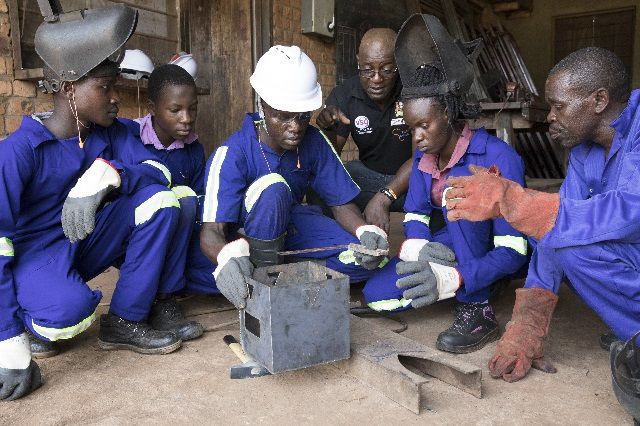
He explained that under the new framework, students are expected to undergo hands-on training in farms, laboratories and workshops while instructors continuously assess their performance.
Kasumba said institutions are required to revise curricula, retrain instructors and adopt teaching methods focused on practical implementation rather than theory alone.
“If a student is on the farm and crops are not growing well, the instructor must follow up to find out whether the learner understood irrigation, pest control, and other practical concepts. That is the kind of learning we want to promote,” he said.
He added that institutions must also accommodate different categories of learners, including those requiring additional supervision during practical training.
The Vice Chancellor of Mountains of the Moon University, Pius Coxwell Achanga, also called for urgent curriculum reforms to ensure graduates acquire skills relevant to modern labour market demands.
Bukalasa Agricultural College, one of Uganda’s oldest agricultural institutions, traces its origins to the 1920s when it operated as a cotton research centre before later evolving into a farm training institute.
According to Lule, the institution became a college in 1960 and has maintained a practical approach to agricultural training throughout its history.
“We started as a research centre for cotton before becoming a farm training institute mainly focusing on practical skills for farmers. Our approach to training has always been hands-on,” he said.
The college currently offers certificate and diploma programmes in agriculture, veterinary science, animal husbandry, agribusiness, aquaculture, agricultural mechanisation and community nutrition.
Lule highlighted the institution’s “four-acre model farm” training system, where students manage crops and livestock enterprises while learning budgeting, planning and farm management.
“We want students to understand how a four-acre model farm can sustain a family and generate income,” he noted.
However, he said rising operational costs are affecting practical learning at the institution.
“Fuel is expensive and when we do not have enough fuel, we cannot continuously pump water for irrigation, yet practical training depends on such systems,” he said.
Students also expressed concern over limited access to land, startup capital and employment opportunities after graduation.
One student, Patience Namude, said she developed an interest in agriculture while in secondary school and hopes to use the skills acquired at the institution to improve food production.
She, however, noted that many graduates struggle to secure land and capital needed to establish agricultural enterprises despite receiving practical training.
