

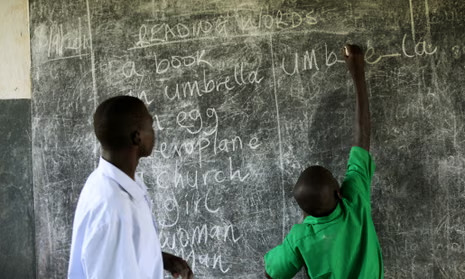
The Uganda National Examinations Board (Uneb) has reported mixed performance trends in the 2025 Primary Leaving Examinations (PLE), with English registering notable improvement compared to 2024, while Social Studies with Religious Education (SST) recorded a significant decline.
Presenting the results, Uneb Executive Director Dan Odongo said overall subject performance showed clear shifts, particularly at Grade 8 and above.
English emerged as the best performed subject in 2025, followed by Integrated Science and Mathematics, while SST was the worst performed.
In English, out of 807,432 candidates who sat PLE in 2025, 10.1 percent attained Distinction 2, up from 4.9 percent in 2024.
At Credit 6 level, 67.6 percent reached the threshold compared to 58.0 percent the previous year. Performance at Pass 8 level also improved, with 91.9 percent achieving the grade in 2025, up from 88.3 percent in 2024.
Uneb described the trend as a positive indicator, noting the importance of English as a core subject and a key measure of literacy at primary level.
The improvement, however, was not mirrored across all subjects. SST recorded the sharpest decline, with Distinction 2 dropping from 7.9 percent in 2024 to 3.3 percent in 2025.
Credit 6 performance fell from 75.6 percent to 62.7 percent, while Pass 8 declined from 91.9 percent to 86.7 percent.
Uneb said the drop was significant and pointed to possible challenges related to teaching effectiveness, learner comprehension and preparation strategies.
Integrated Science performance remained relatively strong but showed declines at key levels.
In 2025, 6.1 percent attained Distinction 2 compared to 6.4 percent in 2024, while Credit 6 performance fell from 73.8 percent to 66.9 percent.
Pass 8 also declined from 93.4 percent in 2024 to 90.5 percent in 2025. Mathematics showed improvement at the top end, with Distinction 2 rising from 7.4 percent to 9.6 percent and Credit 6 improving from 62.7 percent to 66.7 percent, although Pass 8 dipped slightly from 89.4 percent to 88.9 percent.
Beyond subject performance, UNEB reported an increase in the number of candidates attaining Division 1. A total of 91,990 candidates, representing 11.39 percent, achieved Division 1 in 2025, up from 84,301 candidates or 10.7 percent in 2024.
This reflects an increase of 7,689 candidates. Overall, UNEB said 7,503 more candidates passed PLE in 2025 compared to the previous year.
Division 2 remained the largest category, with 388,293 candidates or 48.10 percent in 2025, slightly lower than the 50.5 percent recorded in 2024.
Division 3 remained largely stable at 165,226 candidates or 20.47 percent.
However, Division 4 increased to 84,724 candidates or 10.49 percent, up from 9.6 percent in 2024, while the ungraded category rose to 77,080 candidates or 9.55 percent from 8.2 percent.
Uneb said the rise in Division 4 and ungraded candidates suggests that while more learners reached the top bracket, a sizeable proportion still struggled to meet minimum performance thresholds.
Uneb’s aggregate distribution showed that most candidates scored between aggregate 11 and 30, with the mode at aggregate 22, which the board described as pass levels.
The distribution indicates that national performance remains concentrated in the middle range rather than at elite aggregates.
The results also revealed gender-based performance differences. Girls continued to perform better in English, a trend Uneb described as consistent.
Boys, however, performed slightly better in Integrated Science and SST.
In Mathematics, boys outperformed girls up to Credit 4, with fewer boys appearing in the lower grades of 7, 8 and Fail grade 9.
Overall, the divisional gender breakdown showed males slightly outperforming girls.
Boys recorded 48,220 candidates in Division 1, representing 12.54 percent, compared to 43,770 females or 10.35 percent.
The ungraded rate among males stood at 8.97 percent, while females recorded a higher ungraded percentage of 10.07 percent.
Uneb said the figures indicate that males performed better overall and registered a lower failure rate, even as girls maintained a strong advantage in English.
