

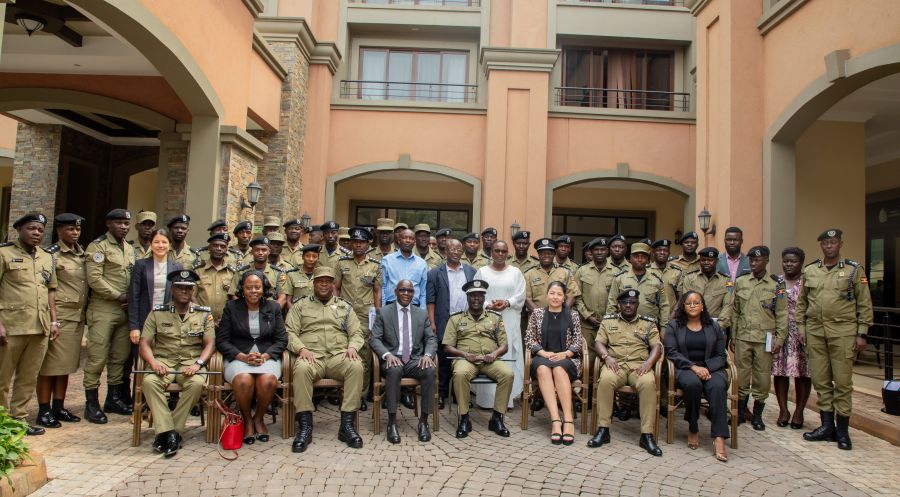
Police have launched guidelines for scenes of crime officers investigating trafficking in persons cases.
The Standard Operating Procedures(SOPs) were launched on Tuesday during a function held at Mestil Hotel in Kampala.
Speaking during the launched, Deputy Inspector General of Police, James Ochaya said the guidelines will play a crucial role in helping scenes of crime officers navigate scenes in trafficking in persons cases that seem discreet and by organized gangs.
“Human trafficking is among the most heinous crimes confronting our society today as it erodes human dignity, exploits the most vulnerable and destroys trust in communities. Combating this crime therefore requires more than just arrests of the perpetrators — but it demands that every step, from the report, prosecution and adjudication is handled professionally and with integrity, while observing the rights of the victims,” Ochaya said.
He said that the crime scene is the theatre where this precision begins, and where the truth is secured, noting that it needs to be secured.
“ If the scene is mishandled—through contamination, procedural error, or oversight—we risk losing irreplaceable evidence, weakening prosecutions, and denying victims justice. .
The Deputy IGP said the SOPs are evidence focused to ensure that every trace is preserved for court, victim-centred, recognizing that the scene can be handled in a way protecting the survivor’s dignity but also reflecting global best practices.
Ochaya urged scenes of crime officers not to keep the SOPs for the shelves but read and understand them.
“They are operational tools, and their value will only be realised when they are used consistently and competently across the country. This will reduce the crime and when they occur, minimise loss of cases and poor evidence handling,” Ochaya said.
The head of the Austrian Embassy Development Cooperation, Dr. Katja Yvonne Kerschbumer said the fight against human trafficking is not optional but a moral and legal imperative.
“Human trafficking is not only a human rights issue—it is also fundamentally an issue of access to justice. Victims are often marginalized, silenced, and denied the ability to seek redress. Without access to justice, trafficked persons remain invisible: unable to reclaim their rights, unable to hold perpetrators accountable, and unable to rebuild their lives. Ensuring access to justice means ensuring that survivors are heard, protected, and empowered,” she said.
Dr.Katja said in order to achieve justice, there is need to secure high-quality evidence.
“Human trafficking cases are complex as perpetrators are often organized, crimes are hidden, and victims may be too traumatized or afraid to testify. This makes it essential to gather strong evidence—digital records, financial trails, travel documents, forensic data, and credible witness statements. Such evidence not only strengthens prosecution but also protects victims from being retraumatized by repeated questioning or hostile courtroom confrontations.”
To this, she said the role of the police and prosecution is central.
“ Police must be trained to identify trafficking cases, treat victims with sensitivity, and pursue investigations that go beyond surface-level crimes. Prosecutors must ensure that cases are built on solid evidence, uphold victims’ rights in court, and seek convictions that reflect the seriousness of the crime. Together, they form the frontline of justice—turning laws on paper into protection in practice.”
She said as development partners, they are committed to working hand in hand with government, United Nations, and with civil society organizations to fight human trafficking.
This is not a challenge that any actor can solve alone—it requires collective action, coordination, and a shared commitment to place the dignity and rights of victims at the center of our efforts.”
The police director for Forensics, Andrew Mubiru said in every case of trafficking, the crime scene is where truth begins to emerge and therefore, needs to be preserved well.
“The crime scene is where the truth begins to emerge. It may be a hidden house, a border crossing, a vehicle, or even a digital environment. Mishandling scenes or losing evidence helps traffickers, harms victims, and undermines justice,” Mubiru said.
He said the SOPs developed by the police, office of the DPP and partners give oofficers and first responders a clear, practical, and standardised guide for securing, documenting, and examining crime scenes in circumstances peculiar to incidents of trafficking in persons whether in Kampala, at a border point, or in a rural district post.
“Human trafficking survivors often carry deep trauma. By handling crime scenes with professionalism and sensitivity, we shall reduce the need for repeated testimony and minimise re-traumatisation. Evidence, when properly secured, can speak powerfully on their behalf and allow survivors to heal while justice takes its course,” Mubiru said.
