

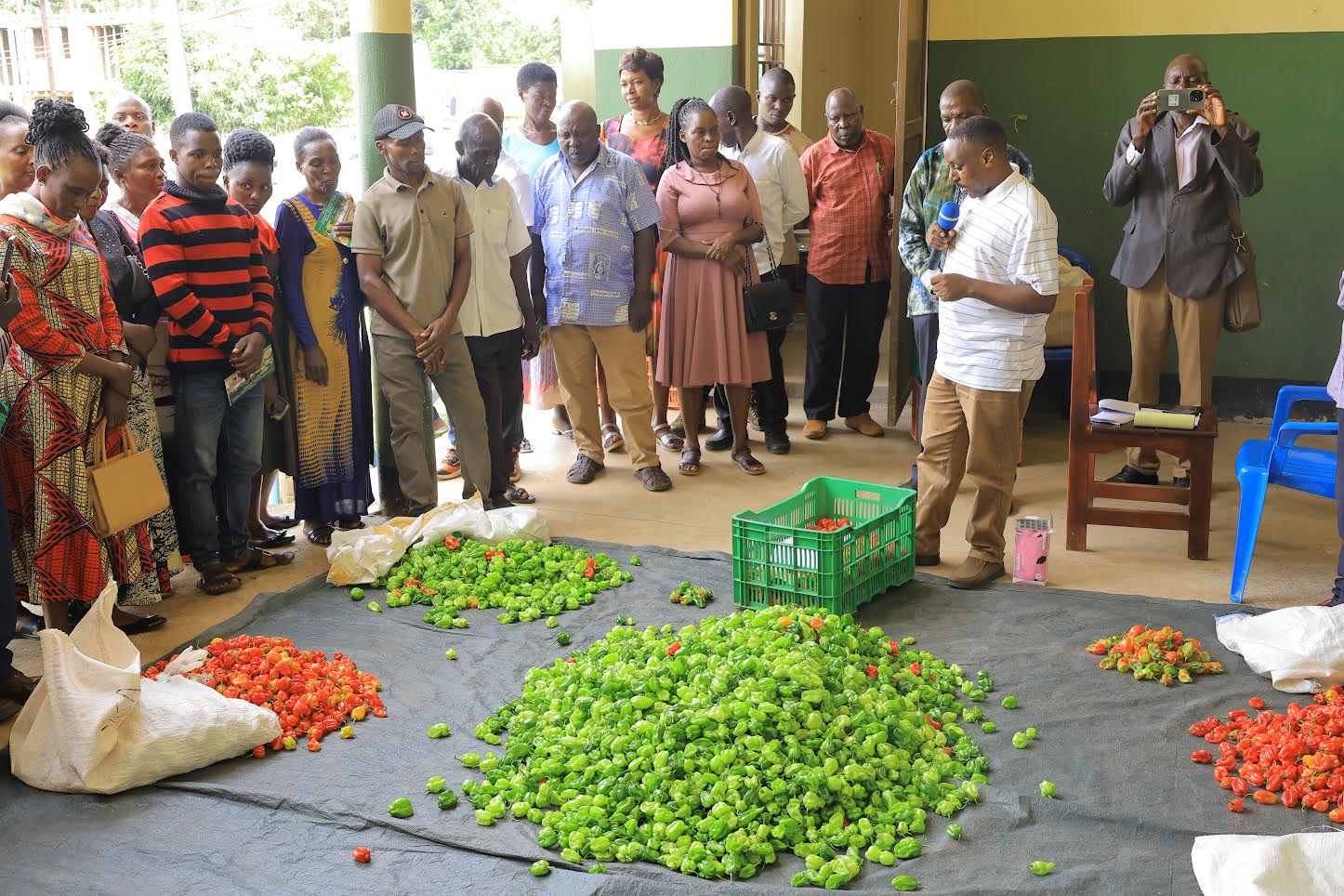
Horticultural farmers in the Bunyoro sub-region have entered a joint venture with local exporter KK Foods to supply fresh produce to Western Europe, including the United Kingdom, in a bid to increase incomes and access international markets.
The farmers, organised under the Albertine Farmers Association (AFA), signed a Memorandum of Understanding (MoU) with KK Foods following a capacity-building training programme.
Speaking at the launch of the venture at the Ageteraine Agro-Processing Facility in Hoima City, the association’s chairperson, Julius Kwamya, said the partnership will initially focus on hot pepper and chilli production.
“During the training, we agreed on the way forward. We will start with hot pepper and chilli, but later scale to other enterprises. These crops offer quick returns due to their short growing cycle and high market demand,” he said.
Demand for chilli products in Europe continues to grow, driven by changing consumer preferences and increasing interest in diverse and spicy cuisines. Key markets include France, Spain, the UK, and Germany.
The joint venture is a key outcome of an August 2025 training programme conducted by Stanbic Business Incubator Limited under the Albertine Agribusiness Development Programme (ADP), in partnership with Uganda National Oil Company.
Kwamya revealed that the association currently has 1,930 registered members, with a target of reaching 10,000 by the end of 2026. However, he cited the shortage of extension workers as a major challenge affecting productivity and called on the government to strengthen agricultural support services at the grassroots level.
Catherine Poran, Chief Executive Officer of Stanbic Business Incubator Limited, commended the farmers for applying the skills acquired during training.
“It is encouraging to see farmers putting theory into practice and being linked to markets. Growing food is one thing, but accessing markets is what truly unlocks value. Our mandate is to support enterprises to scale and realise their full potential as we drive Uganda’s economic growth,” she said.
Nicholas Atukwase, Production Manager at KK Foods, said the company requires at least 50 tonnes of produce per week to meet export demand.
“There is strong demand for chilli and hot pepper. Farmers need to focus on quality, quantity, consistency, and compliance with customer and regulatory requirements,” he noted.
Percy Mucunguzi, National Content Officer for Measurements and Reporting at UNOC, praised the farmers for working collectively and sharing knowledge within their communities.
“We encourage the cascading of knowledge. Building the capacity of Ugandans requires collaboration, and initiatives like this ensure that benefits reach more people,” he said.
Mucunguzi also urged farmers to diversify into other enterprises to increase their income streams, noting that agriculture plays a critical role in supporting sectors such as oil and gas through food supply, transport, and related services.
Emmanuel Blair Niyitegeka, a Senior Agricultural Inspector at the Ministry of Agriculture, Animal Industry and Fisheries, highlighted the importance of meeting international standards to access export markets.
“Hot pepper has high demand in Europe, the Middle East, and parts of Asia, but farmers must ensure their produce is pest-free and meets strict quality requirements,” he explained.
He advised farmers to adopt proper pest control measures, including the use of insect traps and correct pesticide application, to meet export standards—particularly those of the European Union and the UK, which are among the most stringent.
Dr. Charles Kajura, Hoima District Production Officer, emphasised the need for farmer certification and traceability.
“Each farmer must be registered and assigned a code. This allows us to trace produce back to its source in case of quality issues, ensuring accountability and compliance with export standards,” he said.
Addressing the challenge of limited extension services, Dr. Kajura encouraged farmers to organise themselves into groups to improve service delivery.
“We are promoting a group approach so extension workers can reach more farmers efficiently. We are also introducing Community-Based Facilitators who will be trained to support farmers at the local level,” he added.
