

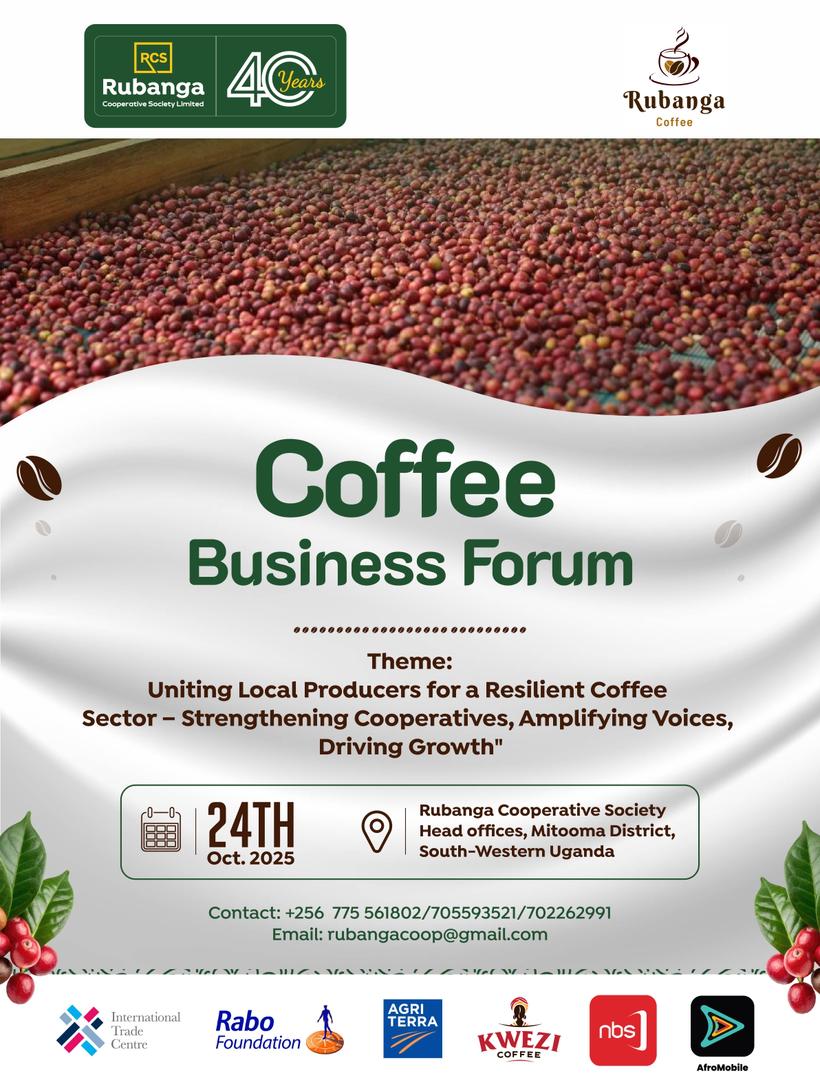
Forty years ago, a group of visionary farmers in South-Western Uganda came together with little more than courage, solidarity, and a dream. They believed that through coffee, they could transform their lives and create a better future for their families and communities. Those founders laid the foundation of Rubanga Cooperative Society, not knowing that their small step of faith would grow into a movement that has now spanned four decades.
As a staff member at Rubanga today, I look back at this journey with admiration. It is a story written with resilience and reinvention, as each generation of farmers built on the sacrifices of those who came before. Above all, it is a story that insists on one truth: producers are the backbone of the coffee value chain. Without them, there would be no industry. And yet, their voices have too often been absent from the conversations that shape the sector — whether in policy, trade, or sustainability.
This is why the Coffee Business Forum was created. It emerged as a space where producers could no longer be overlooked but instead were placed at the center of dialogue. For Rubanga, it represents a platform to connect farmers, policymakers, lenders, and development partners, ensuring that transformation is not spoken about in boardrooms alone, but also in the fields where the beans are grown.
Much has changed since the early days. Farmers who once struggled in isolation now work through cooperative structures that give them bargaining power and access to markets. Improved farming practices have lifted quality and yields, while sustainability certifications have opened doors to international buyers. Yet, challenges remain: financing is still out of reach for many, market prices are unpredictable, and climate change poses real threats. These are the challenges that the Coffee Business Forum seeks to confront collectively, by shining a light on both the problems and the possibilities.
One lesson stands out clearly from the Rubanga story: unity is our greatest strength. When farmers join hands around a shared vision, they unlock opportunities none could achieve alone. That is why this forum is more than just an event — it is a call for producers to unite, to influence policy, to speak as one, and to ensure that benefits are shared more fairly across the value chain.
We must also recognize those who have stood with us on this journey. Impact lenders such as Rabo Foundation, Root Capital, and Shared Interest have given cooperatives like ours the means to survive and grow. Their financing has allowed us to invest in better practices, improve infrastructure, and keep our businesses running even in uncertain times. For us, credit is not just money; it is continuity, resilience, and hope.
Equally important have been our development partners. Agriterra, the European Union, the International Trade Centre, and the Agricultural Business Initiative (aBi), among others, have strengthened us in ways that go beyond finance. They have helped us build stronger governance systems, sharpen our business and leadership skills, and position ourselves in a fast-changing global coffee market. Their support has shown us that partnerships grounded in trust can transform not just cooperatives but entire communities.
As we mark 40 years of Rubanga, the Coffee Business Forum stands as both a celebration and a vision for the future. It reminds us of how far we have come, but also of how much more we can achieve together. This is indeed a journey of a thousand miles — a journey begun by the founders, carried forward by today’s farmers, and enriched by partners who believe in the power of coffee to change lives.
We now invite all who believe in this vision — farmers, policymakers, investors, lenders, and partners — to walk with us on the next leg of this journey. Join us on 24th October 2025 at the Rubanga Cooperative Society grounds in South-Western Uganda for the Coffee Business Forum, as we celebrate forty years of resilience and look ahead to a future where producers stand at the center, their voices strong, their potential limitless, and their impact felt across Uganda and beyond.
Written by Shallot Nankunda
Staff at Rubanga Cooperative Society
