

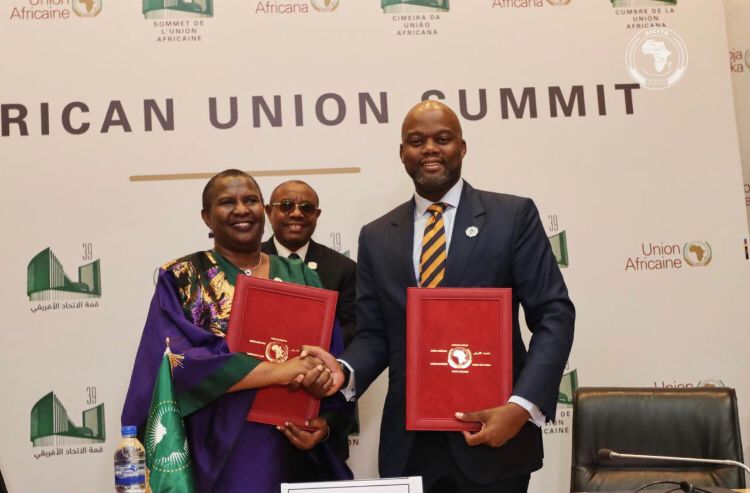
The Alliance for a Green Revolution in Africa (AGRA) and the African Continental Free Trade Area (AfCFTA) Secretariat have signed a Memorandum of Understanding (MoU) designed to unlock intra-African trade and reinforce agri-food systems corridors.
The agreement was formalised on the sidelines of the 39th Ordinary Session of the African Union Summit, as leaders focused on operationalising AfCFTA, the world’s largest free trade area by participating countries.
Signed by AfCFTA Secretary-General H.E. Wamkele Mene and AGRA President Alice Ruhweza, the MoU strengthens cooperation between the two institutions, aiming to translate AfCFTA’s legal framework into tangible outcomes for smallholder farmers, informal cross-border traders, women, and youth.
It will also support resilient agricultural value chains capable of competing in regional markets.
AfCFTA unites 54 African countries with a combined population of over 1.4 billion and a collective GDP exceeding $3.4 trillion (approximately Shs13,000 trillion).
Despite this scale, intra-African trade remains low at around 15% of total exports, compared to nearly 60% in Europe and 40% in North America.
Agriculture, employing roughly 60% of Africa’s workforce and contributing 23% of GDP, remains insufficiently integrated into regional trade systems.
The partnership is anchored in the AfCFTA Agri-Trade Action Plan, which seeks to increase intra-African agricultural trade, eliminate tariff and non-tariff barriers, and promote investment in value-added trade and agro-industrialisation.
By aligning food systems development with trade policy, the institutions aim to enable farmers and agri-enterprises to meet standards, improve productivity, and access regional markets at scale.
While tariff reductions under AfCFTA are ongoing, non-tariff barriers—including inconsistent product standards, limited certification services, weak logistics infrastructure, and fragmented market information—continue to limit trade flows.
The MoU commits both institutions to harmonise standards, strengthen trade facilitation, and develop efficient agri-food systems corridors linking high-production zones to major consumption markets.
These corridors are expected to reduce post-harvest losses, lower transport costs, and improve compliance with sanitary and phytosanitary requirements, unlocking private sector investment in storage, cold chain, and agro-processing facilities.
According to the United Nations Economic Commission for Africa (UNECA), full AfCFTA implementation could boost intra-African trade by more than 50% by 2030, with agricultural trade projected to increase over 30% if supply-side constraints are addressed.
The AGRA–AfCFTA partnership is positioned as a catalyst for this growth.
For smallholder farmers—responsible for up to 80% of Africa’s food production—the agreement could stabilise incomes, incentivise productivity, and stimulate rural industrialisation by linking production hubs to regional demand centres.
The collaboration is also expected to enhance food security, create decent employment, and strengthen competitive African food systems.
Africa currently imports over $50 billion (Shs190 trillion) in food annually, highlighting the importance of regional value chains for cereals, horticulture, livestock, and oilseeds.
By promoting value addition and agro-processing within Africa, the MoU could reduce import dependence and ensure greater retention of economic value across African economies.
The signing signals a shift from policy ambition to practical implementation, emphasising measurable impacts: improved farmer incomes, stronger regional value chains, and enhanced food resilience.
By integrating trade frameworks with agricultural transformation, AGRA and the AfCFTA Secretariat are placing agriculture at the center of Africa’s economic integration agenda.
