

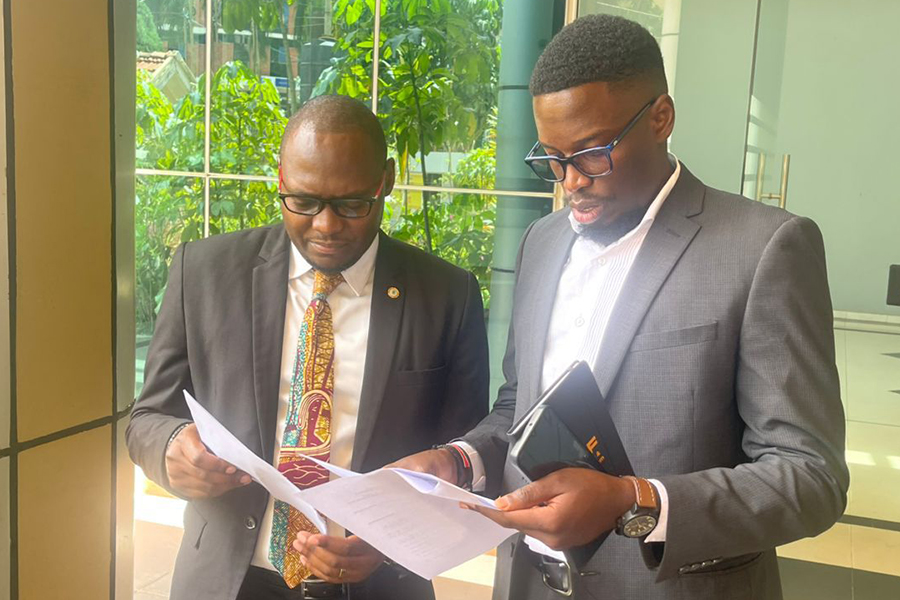
Two lawyers have filed a petition in the High Court challenging the legality of the nationwide internet shutdown imposed between January 13 and January 18, arguing that it violated multiple constitutional rights and caused significant personal, professional, and economic harm.
The shutdown, which coincided with Uganda’s January 15 general elections, was only partially lifted on Sunday, days after voting had concluded.
The petition names the Uganda Communications Commission (UCC), MTN Uganda, Lyca Mobile, and Airtel Uganda as respondents.
The applicants, Michael Aboneka and Raymond Amumpaire, contend that the blackout unlawfully interfered with freedom of expression, access to information, education, professional work, participation in governance, and the ability to earn a livelihood.
They are asking court to declare the shutdown illegal and unjustified, order the full restoration of internet services, award each applicant Shs100 million in compensation, compel telecom companies to refund unused data bundles, and issue orders barring future arbitrary internet shutdowns.
Aboneka, a practicing lawyer and PhD student at the University of Pretoria, told court that the blackout severely disrupted both his academic and professional commitments.
He said he missed scheduled meetings with his doctoral supervisor, failed to submit an international conference visa application, and lost approximately $3,500 in income from cancelled online training sessions.
“I rely on the internet for court filings, client communication, research, teaching, and academic work,” Aboneka stated. “The shutdown made it impossible to carry out my work or pursue my studies.”
Amumpaire, who is also a lawyer and a student, described similar disruptions. He said the blackout prevented him from attending online classes, filing court documents, meeting clients, and accessing real-time electoral information.
He argued that the shutdown not only affected his professional duties but also curtailed his ability to participate meaningfully in civic and democratic processes.
The applicants argue that the internet shutdown had no clear legal foundation. They contend that UCC directed internet service providers to suspend services without citing any enabling law, issuing a public explanation, or demonstrating that the measure was necessary and proportionate.
They further argue that the shutdown was abrupt, imposed without public notice, and caused widespread and avoidable harm.
The petition details losses arising from missed court filings, disrupted academic work, blocked access to news and electoral updates, and loss of income, describing the shutdown as “an extreme and unjustified restriction on digital rights.”
The lawyers are represented by M/S MOM Advocates and M/S Thomas and Michael Advocates. The petition emphasizes that the case is being brought not only in their personal capacity but also as a matter of public interest, with the aim of preventing future arbitrary restrictions on internet access.
The petition further argues that internet access is now central to education, professional practice, civic participation, and access to timely information, and that its disruption violates fundamental rights guaranteed under the Constitution, including freedom of expression, access to information, the right to education, and participation in public affairs.
“The internet is no longer a luxury; it is a lifeline for education, work, civic engagement, and access to information,” the petition states. “Arbitrarily cutting access violates human rights and weakens democratic governance.”
The High Court is expected to schedule a hearing later in 2026. The applicants are seeking interim relief to ensure uninterrupted internet access and a permanent order restraining future shutdowns without due legal process.
The case raises broader questions about state control over digital infrastructure, the obligations of telecom service providers, and the protection of digital rights in Uganda, particularly during election periods when access to information is most critical.