

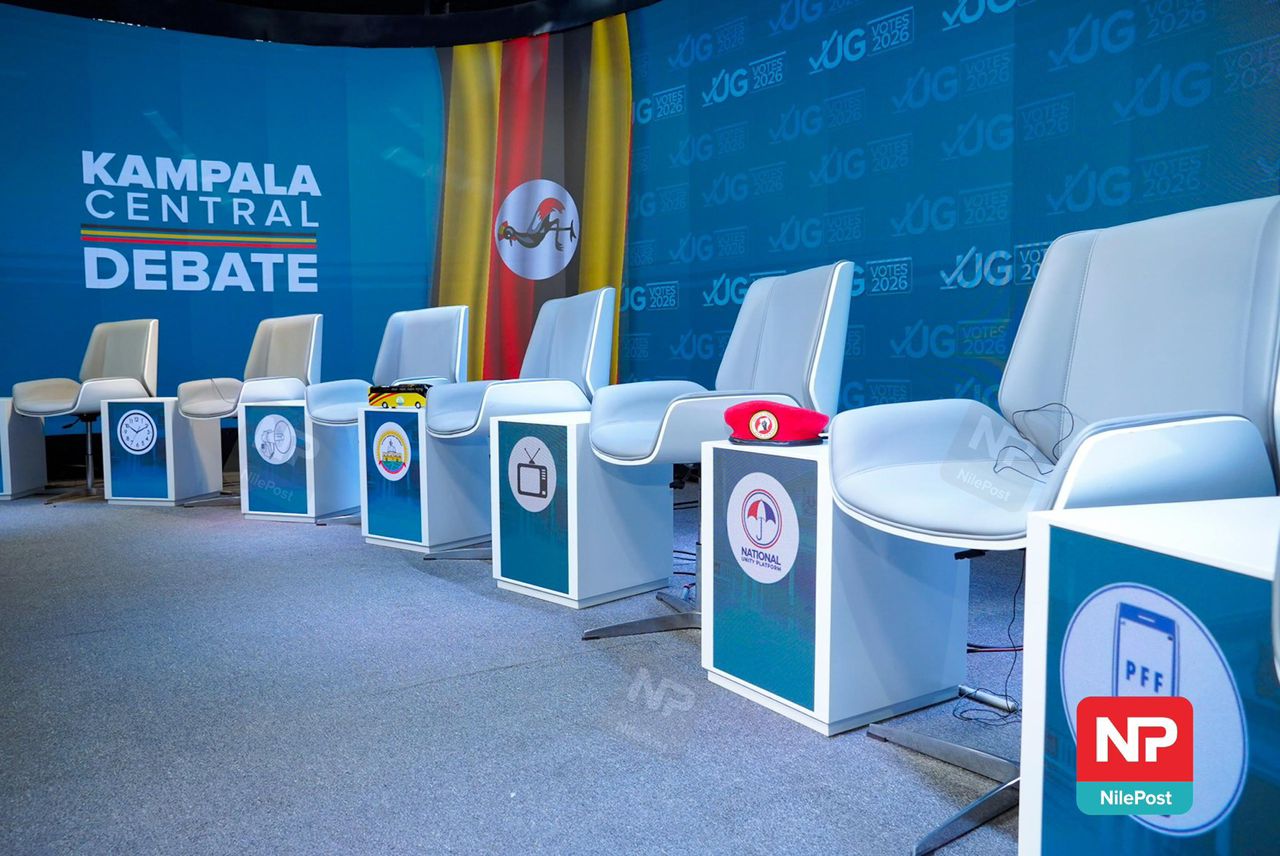
NBS Television’s decision to leave empty, party-branded seats on its debate set after NUP’s David Lewis Rubongoya and NRM’s Minsa Kabanda failed to show up stirred a predictable wave of online criticism.
This was during Wednesday's Kampala Central parliamentary candidates debate.
Supporters of NUP, in particular, accused the station of bias, stage-managing optics, and “forcing” a debate onto parties that had chosen not to attend.
But the use of empty chairs in political debates is not a Ugandan invention, nor is it a hostile act. It is a long-standing editorial device used by broadcasters around the world to show viewers that candidates were invited, expected, and chose not to appear.
In this case, NBS’s choice is entirely in keeping with international precedent and serves a democratic purpose that often goes unnoticed in the heat of partisan reactions.
A particularly relevant example comes from Britain. In November 2019, Channel 4 hosted a leaders’ debate on climate change in the thick of the general election contest.
Prime Minister Boris Johnson did not attend, and neither did Nigel Farage. Because the debate was strictly for party leaders, Channel 4 turned away senior Conservative Michael Gove, who attempted to participate in Johnson’s place.
Rather than quietly ignore the prime minister’s absence, Channel 4 placed a melting block of ice at the podium bearing the Conservative Party’s name. It did the same for the Brexit Party.
The symbolism was blunt but effective: the leaders had been invited, the stage had been prepared for them, but they were not there.
The Conservatives launched a furious complaint to the media regulator, Ofcom, accusing the broadcaster of bias. Ofcom rejected the complaint and ruled that Channel 4 acted within acceptable editorial limits.
The ice sculptures, the regulator concluded, were a permissible way to mark an absence without lampooning the absent leaders personally.
That British example shows why “empty-chairing” persists in various democracies. It is not done to embarrass a candidate, even though in today’s media climate it naturally comes with political cost.
It is done for transparency. When a chair is left empty, the viewer or voter knows instantly that someone important to the contest was expected and did not come.
If the broadcaster simply removed the seat and pretended the race involved only those present, the audience would not know who declined the invitation.
In a political context where accusations of bias are constant, the act of leaving the chair is itself a form of accountability. It shows that the broadcaster did its part in inviting all sides.
But empty-chairing does more than simply display absence. It works at multiple editorial levels. One is visual signalling: an empty, branded seat silently but powerfully conveys that the debate is incomplete.
It anchors the viewer’s understanding that the contest involves more players than the voices currently on screen.
Another is political pressure. Broadcasters know that parties fear the optics of non-attendance. By leaving the seat visible, the station is not punishing anyone; it is simply letting the viewers draw their own conclusions. That alone can nudge candidates to take future debates more seriously.
There is also the matter of defending against claims of bias. If NBS had removed the seats, critics would almost certainly have accused it of marginalising NRM or NUP by erasing them from the visual frame.
Keeping the chairs in place is the safer editorial choice. It shows the broadcaster invited everyone, prepared space for everyone, and did nothing to exclude those who chose not to show up.
That transparency protects the broadcaster from later accusations that it only platformed certain voices while quietly burying others.
And beyond that lies the broader concept of visual framing. Debates are not only about spoken words—audiences interpret the stage, the composition, the symbolism. An empty chair frames the conversation as one in which the absent parties still matter.
It prevents the debate from misleading viewers into thinking the field is smaller or simpler than it really is. It reminds audiences that democracy is bigger than those who happen to appear on a given night.
That reminder is especially important in contexts where certain parties or candidates may skip debates because they perceive strategic advantage in denying opponents a shared platform.
The.empty-chairing tradition predates the modern social-media era. From the United States to Argentina and Chile, broadcasters have at times left seats, lecterns or labels in place for absent candidates.
It is especially common when frontrunners or incumbents decline to attend debates because they see little political advantage in doing so. The empty chair then becomes a quiet but powerful reminder to the public that the democratic field is wider than the faces visible on screen.
That is the context in which NBS’s decision should be understood. By keeping the NUP and NRM seats on stage, the station signaled clearly that those parties were part of the contest and that they had been given the opportunity to participate.
It also allowed viewers to see that the candidates present were not the only ones seeking the position under discussion. In an election environment where perception matters as much as substance, this visual cue helps ensure the debate does not mislead viewers into thinking the race has fewer contenders than it does.
The decision also quietly underscores that the absent parties carry responsibility for their own visibility; the broadcaster cannot be expected to hide their non-attendance.
The criticism from NUP supporters, while predictable, overlooks this basic function. An empty seat is not coercion, nor is it an attack. It is a factual display: the station invited you, the set was ready for you, and you did not come.
That message would have been just as true if NRM supporters had been the ones crying foul. If NBS had removed the chairs instead, the same supporters might have accused the station of airbrushing their party out of the programme.
The broadcaster, in this case, chose the option that most transparently reflects reality. It is the option that withstands scrutiny, because it preserves the evidence of invitation and makes the record visible to anyone watching.
Whether one agrees with the tactic or not, the empty chairs did exactly what they were meant to do: inform viewers of who was supposed to be there and who was not.
In political communication, clarity is a rare commodity. Sometimes, an unoccupied seat is the clearest statement a broadcaster can make.
