
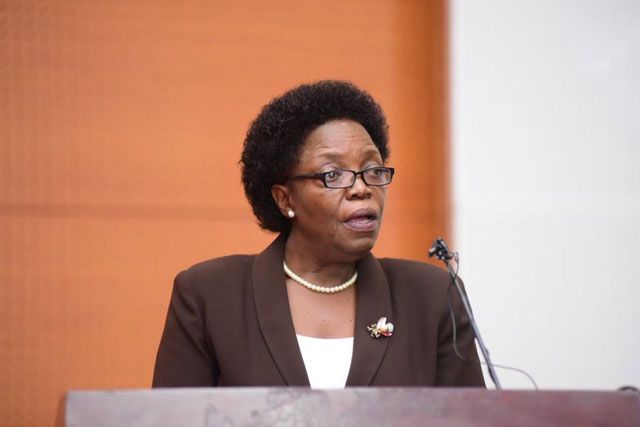
The Executive Director of the National Council for Higher Education (NCHE), Prof Mary Okwakol, has called for amendments to Uganda’s higher education laws to empower the regulator with stronger enforcement powers to shut down non-compliant institutions.
Prof. Okwakol said the current legal framework limits NCHE’s ability to physically close institutions whose licences have been revoked, allowing some universities and tertiary institutions to continue operating despite failing to meet minimum standards.
She made the remarks after a meeting with officials from Somalia, where Uganda’s regulator is providing technical support as the country develops its higher education oversight systems.
“A licence is revoked, and that institution is supposed to close. The institution files a case in court and gets an interim order. As long as that interim order is enforced, you cannot proceed to enforce,” Prof. Okwakol said.
She warned that such legal delays allow some institutions to continue operating even after serious regulatory breaches have been identified.
“In the meantime, the institution continues operating with the non-compliance areas for which you revoked the licence,” she added.
Prof. Okwakol said the situation has exposed gaps in the law and underscored the need to grant NCHE direct enforcement powers similar to those available to other regulatory agencies.
“There is need for amendments of the law. There is need to empower the National Council for Higher Education to enforce,” she said.
She noted that while other government agencies have authority to physically shut down premises, NCHE currently lacks such enforcement capacity.
“There are some organisations or entities that in their laws have powers to close — and closing means physically closing and putting blocks — but the law does not give us that power,” she said.
The NCHE Executive Director also revealed that the council is drafting closure regulations aimed at streamlining procedures for shutting down institutions that fail to comply with national academic, staffing and infrastructure standards.
“We are coming up with closure regulations to streamline the closure of institutions once they have not complied with the requirements,” she said.
Her remarks come amid growing scrutiny of private universities and tertiary institutions over compliance with accreditation, staffing and infrastructure requirements.
On international cooperation, Prof. Okwakol said Somalia had requested Uganda’s support in strengthening its regulatory systems for higher education.
She said the Somali delegation sought guidance on accreditation, quality assurance and institutional monitoring as it builds its regulatory framework.
Meanwhile, the Vice Chairperson of Somalia’s National Commission for Higher Education, Mohamed Ali Farah, said Somalia is seeking to learn from Uganda’s long experience in regulating universities.
“Our institution is new, so we need to see other institutions with long experience in regulating higher education,” Dr. Farah said.
He said Uganda’s NCHE had shared detailed processes on accreditation, monitoring and national qualifications frameworks during the engagement.
“We agreed together to receive full assistance from them,” he said, adding that the two institutions are expected to sign a memorandum of understanding to formalise cooperation.
Dr. Farah said Somalia hopes to apply lessons from Uganda to strengthen its oversight of universities and improve quality assurance systems.
The engagement underscores growing regional cooperation in higher education regulation as countries in East Africa and the Horn of Africa move to harmonise standards and strengthen institutional accountability.
