

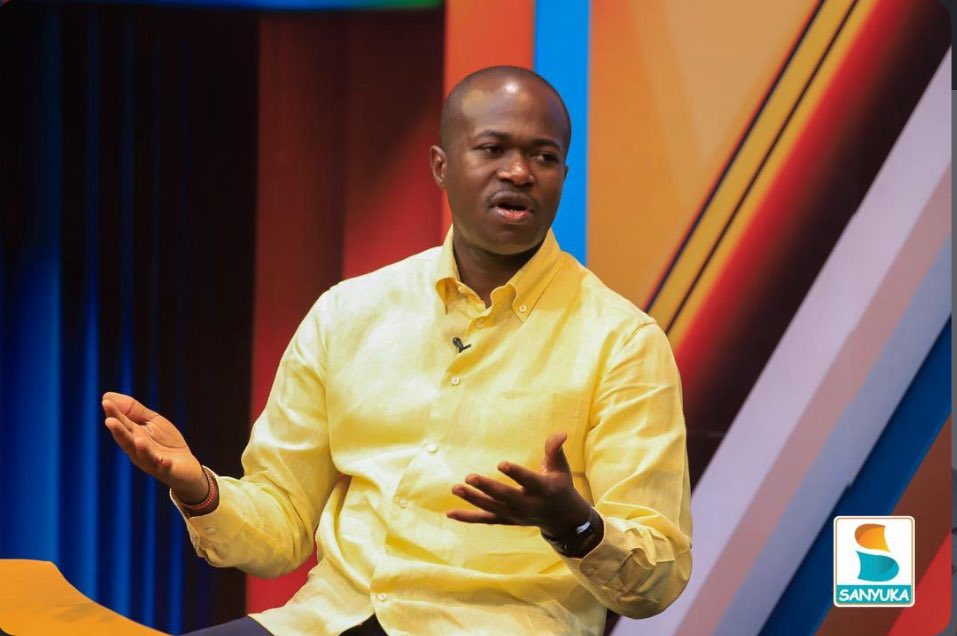
Daudi Kabanda has now fled X, the very platform where he built his stiff collar and cultivated an image that, until Tuesday evening, made him appear like a commander-in-chief of an unfolding political offensive against the then embattled Speaker Anita Among.
It was on that digital battlefield that Kabanda’s voice grew louder, sharper, and increasingly central to the conversation, projecting influence far beyond his formal institutional standing.
Yet the same space that elevated him has now become the arena of his retreat. Kabanda’s deactivation of his account came in the aftermath of a wave of online backlash triggered by the latest Cabinet reshuffle and the broader recalibration of political fortunes within the ruling ecosystem.
The optics were unforgiving: allies linked to his orbit were retained or promoted, while he himself remained outside the Cabinet structure, a contrast that intensified scrutiny of his political weight. It didn't help his grandstanding that political upstart Justine Nameere with whom he engaged in an ugly spat on X is now a minister.
This moment of retreat cannot be separated from the political storm that preceded it. In the period when investigations and allegations of corruption and illicit enrichment engulfed Anita Among, Kabanda emerged as one of the most visible and uncompromising online commentators.
He did not simply observe events; he narrated them in real time, often posting regular updates on the alleged fate of Among and those around her political circle. His commentary gave the impression of proximity to unfolding state action, even when he held no formal investigative mandate.
At the height of that period, Kabanda’s tone hardened into something more combative than commentary. Ministers and political figures who attempted to engage him in cordial terms on X, often referring to him as “brother,” were met with a blunt and increasingly symbolic rejection: “I’m not your brother.”
That phrase, repeated in different exchanges, came to define his online posture, signalling distance, authority, and a refusal to soften his public stance even when political etiquette might have demanded otherwise.
His perceived proximity to General Muhoozi Kainerugaba further amplified the perception that Kabanda was operating with unusual political backing. Within that context, his visibility online took on the aura of authority, and his interventions were often read less as opinion and more as signals of power.
For a moment, he appeared to occupy an outsized role in the political theatre around the collapse of trust and influence within sections of the ruling establishment.
The turning point, however, came as the same political environment began to recalibrate. The fall from grace of Anita Among, once a central figure in Kabanda’s political proximity, exposed a striking reversal: the man who had once been seen alongside her in political circles, public functions, and even international engagements had become one of her most vocal commentators during her moment of vulnerability.
That abrupt shift from proximity to public scrutiny now sits at the centre of questions about loyalty and political judgement.
Kabanda also expanded his confrontational style beyond that episode, engaging in public exchanges with figures such as Justine Nameere, further cementing his reputation as a political actor comfortable with escalation in both digital and physical spaces.
At the Jacob Oboth-Oboth thanksgiving, his conduct on the podium, where he issued what some interpreted as firm directives to attendees, reinforced perceptions of an increasingly assertive and unrestrained political communicator.
It is in this reversal that the political cost becomes most visible. In environments where trust is currency and discretion is power, Kabanda’s hyper-visibility has begun to look less like strength and more like exposure. The emerging perception is not merely that he spoke too loudly, but that he may have spoken too freely in spaces where silence often carries more weight than commentary.
This is where the deeper political risk now emerges. In many political calculations, individuals who operate at the intersection of informal influence and formal ambition are often judged not only by what they say, but by what they might later reveal or reinterpret.
The consequence is that Kabanda, once seen as an energetic enforcer within a rising political network, now risks being viewed as a liability—someone others may hesitate to fully trust. A spy. Or worse.
That is the steep price now attached to his collar he chose to prop. Many within political circles are likely to distance themselves, not necessarily out of hostility, but out of caution. In such an environment, perception can be decisive, and the perception that he has functioned as an aggressive spy may linger longer than any single political episode.
It remains unclear why he deactivated the account but social media can be unforgiving and depressing. Gen Muhoozi attempted to soften the narrative around him, stating: “My young brother Hon. Kabanda is the General Secretary of the Patriotic League of Uganda, a much more important position than being a cabinet minister… Kabanda will get a ministerial job when Todwong gets one.”
The message, read by some as reassurance and by others as political signalling, underscored that Kabanda still retains pockets of high-level sympathy, even amid growing public mockery.
For now, Kabanda’s political standing sits in an uneasy balance between continued relevance and emerging isolation. The same visibility that once made him appear central to unfolding political shifts has now left him exposed to suspicion.
And in that shift lies the core of his current predicament: in trying to be everywhere at once, he may have made it harder for anyone to fully trust where he stands.