

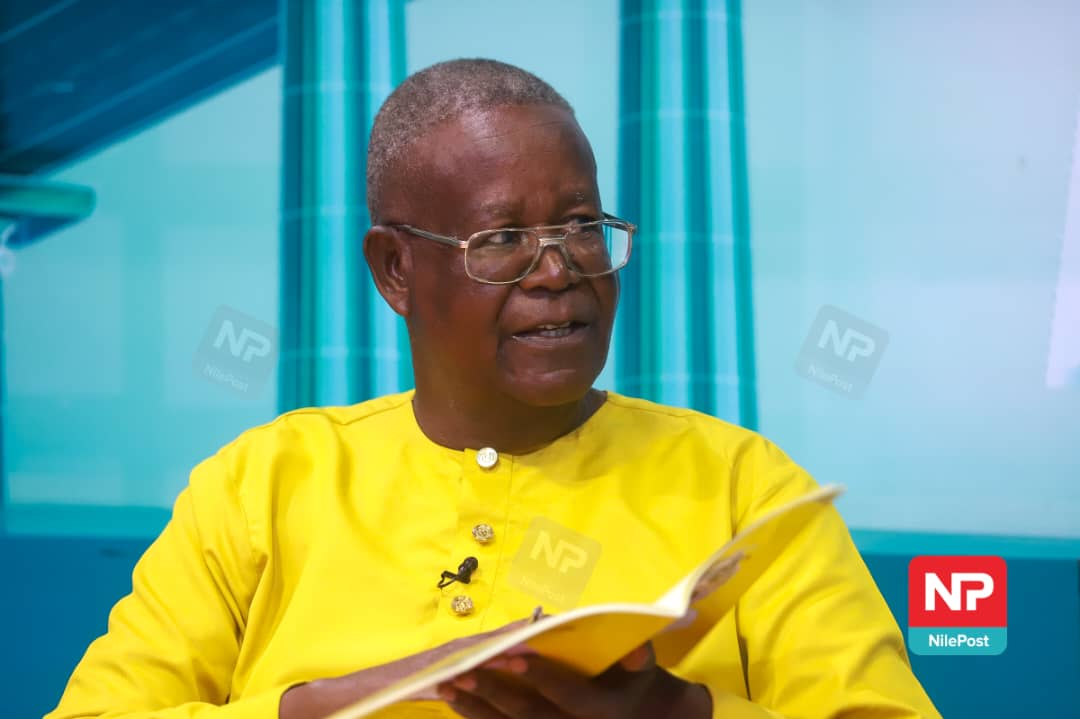
President Museveni’s latest Cabinet reshuffle has delivered an unexpected political return for Prof. Ephraim Kamuntu, the 80-year-old economist and veteran politician who has been appointed Minister of Internal Affairs, marking a striking comeback for one of Uganda’s longest-serving public figures at a time when several senior ministers have exited government.
When President Museveni unveiled his latest Cabinet reshuffle on Tuesday evening, several familiar faces disappeared from the centre of power.
Some long serving ministers quietly exited government after years in office, a move many initially interpreted as the gradual winding down of the National Resistance Movement’s old guard.
But tucked within the lengthy list of appointments was one unexpected political return.
Prof. Ephraim Kamuntu, an 80-year-old academic, economist and veteran politician, was recalled to Cabinet and handed one of government’s most sensitive portfolios, Internal Affairs.
In a reshuffle that pushed out senior historical figures such as Moses Ali and Matia Kasaija from ministerial positions, Kamuntu’s return stood out sharply.
While several veterans were edged aside, Museveni chose to bring back one of the oldest and longest serving figures in Uganda’s political establishment.
Kamuntu replaces Gen. Kahinda Otafiire, who was moved to the Ministry of Water and Environment.
For many, the appointment is likely to be more than a routine reshuffle. It could be another indication of Museveni’s continued reliance on trusted historical allies, particularly individuals viewed as disciplined administrators with deep institutional memory.
Kamuntu’s return also completes a remarkable political rebound.
Just five years ago, the veteran politician appeared headed for political retirement after losing the Sheema South parliamentary seat in the 2021 elections to Prof. Elijah Dickens Mushemeza. The defeat was widely viewed as the symbolic end of a political career that had stretched across multiple governments, ministries and generations.
Yet the seasoned politician quietly reorganised, returned to the campaign trail and reclaimed the constituency in the 2026 general elections, placing himself once again at the centre of national politics.
Now, only months after returning to Parliament, he has re-entered Cabinet.
For Kamuntu, the appointment represents another chapter in a public life that has moved between academia, business, exile politics and state administration for more than five decades.
Long before he became a Cabinet minister, Kamuntu belonged to a generation shaped by Uganda’s political turbulence of the 1970s. During the rule of Idi Amin, he became associated with exile political movements opposed to the military regime, including links to the Save Uganda Movement.
Away from politics, Kamuntu built much of his early career in academia and economics, lecturing at the University of Nairobi and later at Makerere University, where he helped shape economic and management education.
His academic credentials later took him to the United States, where he pursued advanced studies in systems analysis, management science and business administration.
The technocratic side of his career later pushed him into Uganda’s financial and private sector reform circles, including leadership roles in banking and economic liberalisation programmes in the 1990s.
But politics eventually pulled him fully into government.
Since entering elective politics in 2001, Kamuntu has served in several ministries, including industry, finance planning, tourism and water and environment, building a reputation as a calm, technocratic operator often trusted with complex assignments.
His most visible tenure came in tourism, where he played a central role in promoting Uganda as a global destination.
Despite his long service, Kamuntu has largely avoided the confrontational political style associated with many senior figures in the ruling establishment, instead cultivating an image of a technocrat turned political insider.
The Internal Affairs docket he now assumes is among the most sensitive in government, overseeing immigration, citizenship, national identity systems, prisons and aspects of internal security.
For an 80-year-old politician, the appointment inevitably raises questions about generational transition in Uganda’s leadership, as debates continue over whether experience should outweigh renewal in key state institutions.
At the same time, Kamuntu’s return underscores a recurring feature of Uganda’s politics: the enduring reliance on long-serving political figures, even as discussions about succession and leadership renewal intensify.
At an age when many of his contemporaries are exiting public life, Prof. Kamuntu is instead stepping back into one of government’s most powerful ministries, continuing a political journey that has stretched across decades, regimes and roles.