

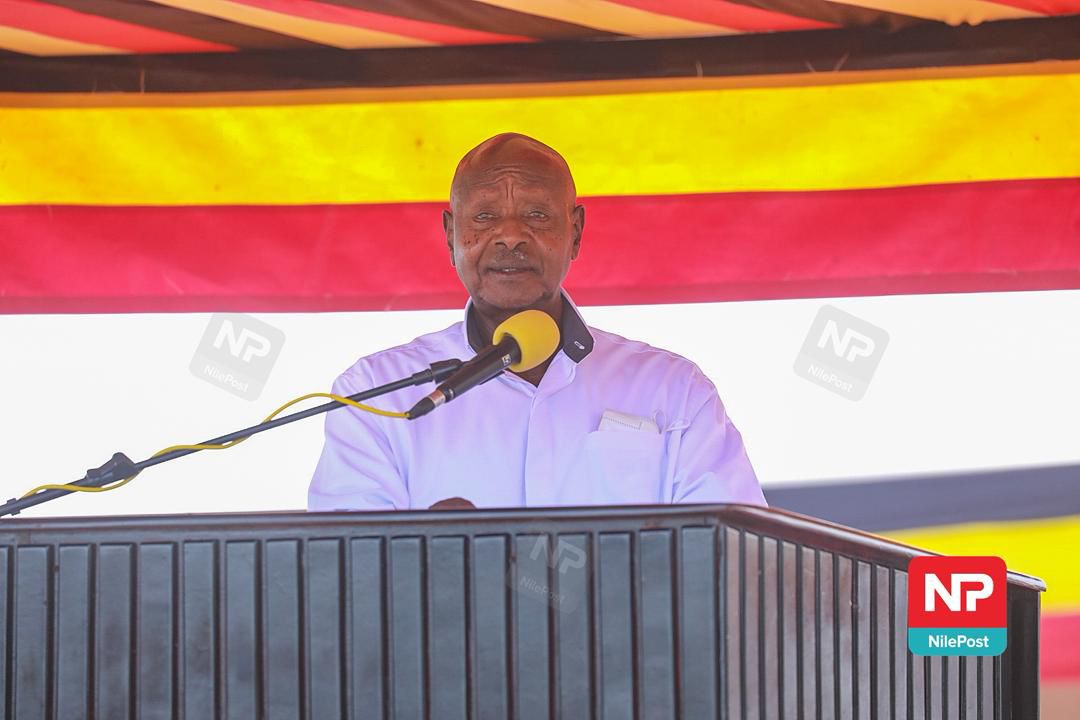
President Museveni has said Uganda’s unemployment challenge stems less from a shortage of jobs and more from citizens’ failure to utilise available opportunities, particularly in agriculture.
Speaking during the International Labour Day celebrations at Nkoyoyo Boarding Primary School in Matale, Buikwe District on Friday, Museveni said the country’s economic potential remains largely untapped.
He noted that Uganda has about 40 million acres of arable land, yet only around 7 million acres are productively used. He argued that if each acre supported 15 jobs, the country could generate up to 105 million jobs—more than double its population.
“The problem is not the lack of jobs; the problem is that people are asleep,” Museveni said, urging Ugandans to shift their mindset and invest in agriculture and value addition.
He also blamed poor business planning for the high failure rate among startups, cautioning entrepreneurs against relying on high-interest commercial bank loans.
Instead, he encouraged borrowing from the Uganda Development Bank, which offers relatively lower interest rates of between 10 and 12 percent, and pointed to government initiatives such as the Parish Development Model aimed at boosting grassroots economic growth.
Museveni further revealed plans to require industrial parks to allocate land for worker accommodation to improve productivity and living conditions.
He also raised concerns about the mismatch between education and labour market needs, noting that many graduates pursue courses that do not align with economic demand. Government, he said, will work to ensure institutions produce job-ready graduates.
The President questioned the investment strategy of the National Social Security Fund, suggesting it should channel more resources into high-return ventures such as infrastructure projects, including toll roads, rather than focusing heavily on government bonds.
His remarks come shortly after he assented to the Employment (Amendment) Act, 2025, which updates the Employment Act of 2006 to strengthen worker protections but leaves out a national minimum wage.
Uganda continues to operate without an enforceable minimum wage, despite increasing pressure from labour unions and civil society groups. Although a Minimum Wages Advisory Board framework exists, it has not been operationalised, leaving wages largely determined by market forces.
Analysts warn that without clear wage benchmarks, legal protections may not significantly improve living standards, particularly for workers in informal and low-income sectors.
The amended law introduces several reforms targeting vulnerable workers, including domestic workers, casual labourers and migrant employees.
It formally recognises domestic workers and provides safeguards against exploitation such as excessive working hours, forced labour and abuse.
It also strengthens oversight of recruitment agencies involved in foreign employment, requiring licensing, proper documentation and enforceable contracts for migrant workers.
Other provisions include mandatory nursing breaks for breastfeeding mothers, conversion of casual employment into formal contracts after six months of continuous service, expanded protections against sexual harassment across all workplaces, and clearer guidelines on severance pay and sick leave.
The legislation, initially tabled in 2022 and passed in 2023, was returned by Museveni for reconsideration before being revised by Parliament’s Gender, Labour and Social Development Committee.
Despite these reforms, the absence of a minimum wage remains central to the national labour debate, with stakeholders questioning whether improved legal protections alone can translate into better livelihoods.
As Uganda marks Labour Day, attention is now turning to whether the government will move to implement a comprehensive minimum wage policy.