

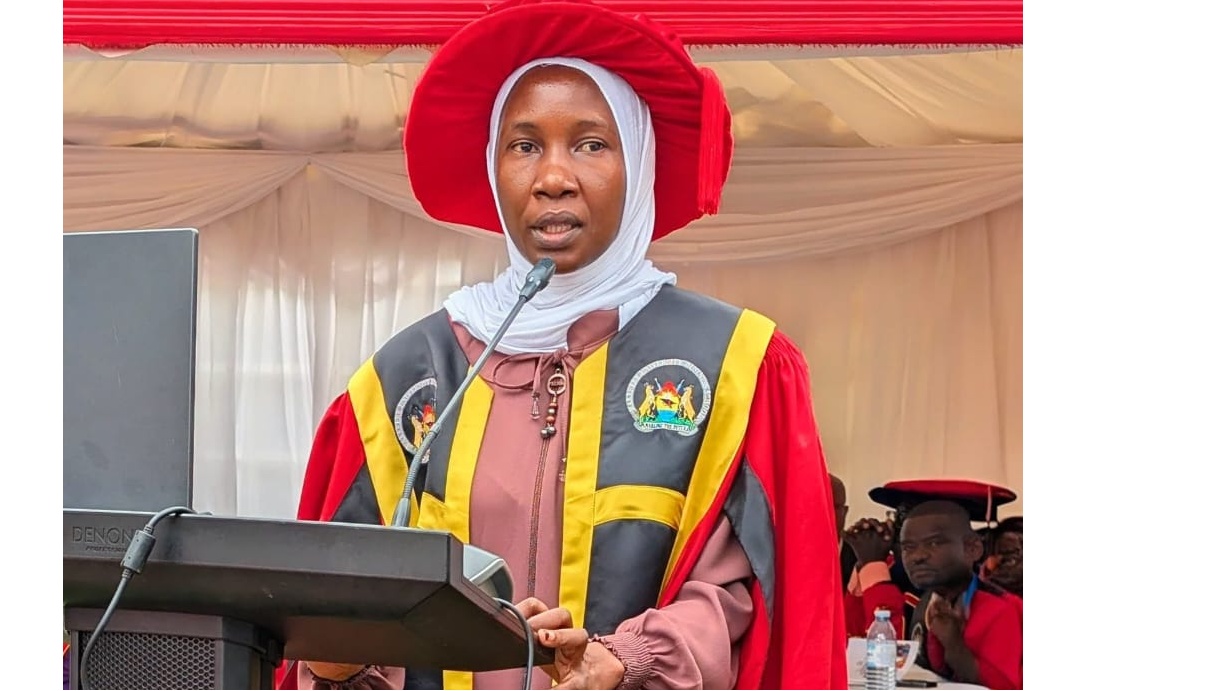
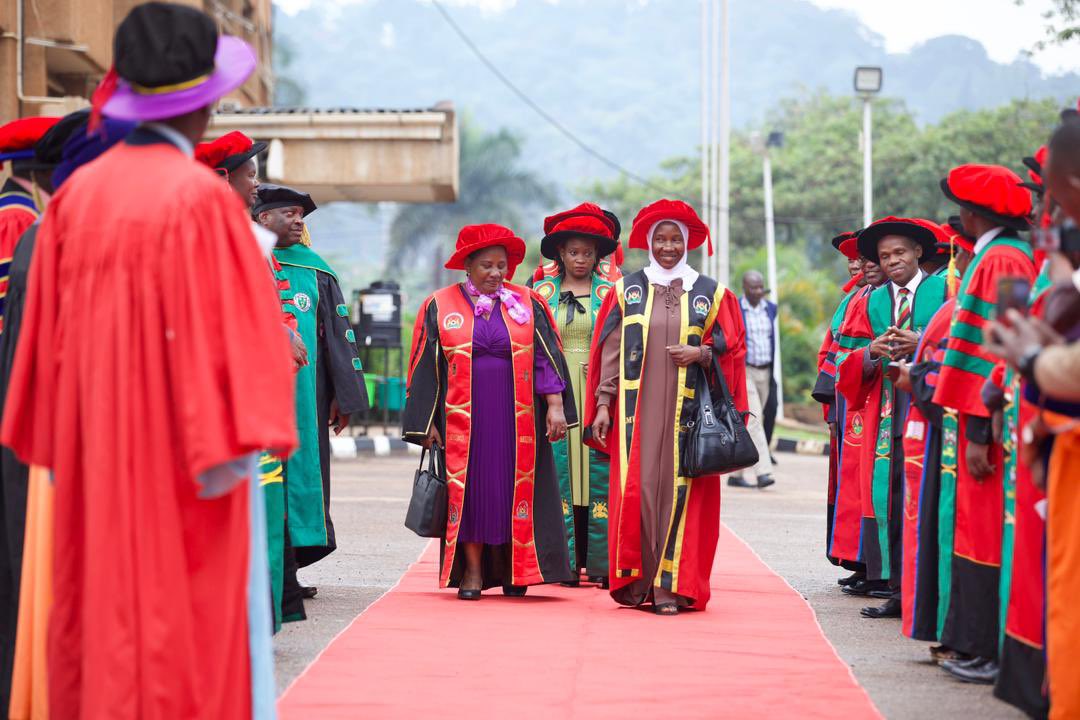
Makerere University Business School, MUBS, on Thursday marked a historic academic milestone after hosting its first-ever Professorial Inaugural Lecture in the institution’s 30-year history.
At the event, Professors Janatti Kyogabiirwe Bagorogoza and Sheila Namagembe presented research that underscored the power of knowledge and innovation in national development.
The inaugural lecture drew scholars, students and university leaders, reflecting on the growing role of research and academia in shaping national transformation.
MUBS Principal Prof. Moses Muhwezi described the lecture as a landmark moment for the institution, saying it represents a new chapter in strengthening the culture of scholarship and intellectual engagement.
“Today’s Professorial Inaugural Lecture is the first of its kind in the 30-year history of MUBS, marking a major milestone for the institution’s academic growth,” Prof. Muhwezi said.
He added that the university intends to institutionalize the lectures as a regular academic tradition that connects research to real societal challenges.
“If you see, this is the first time we’re doing this, we shall make this a practice and use such an opportunity to connect MUBS with society so that we can demonstrate our relevance to solving societal problems using our research,” he said.
Prof. Muhwezi also urged scholars to actively engage in national conversations and use their academic training to provide reasoned solutions to complex challenges.
“Because we have not taken our respective positions, the ghetto community has hijacked that platform. We must go back to this platform. It is possible because we are trained to understand the world through reasoning and interpret it to others,” he noted.
In her lecture, Prof. Janatti Kyogabiirwe Bagorogoza reflected on her academic journey and emphasized the central role of knowledge management in transforming institutions and societies.
“Knowledge positions itself as the primary driver of sustainable development. While capital investment, infrastructure expansion and technology adoption are critical, they remain insufficient without the strategic mobilization of human resources or human knowledge,” she said.
Prof. Bagorogoza explained that sustainable transformation depends largely on human capital, particularly the skills, creativity and adaptive capacity within institutions.
“The skills, the competences, the tacit knowledge that is within you, creativity and innovation and the adaptive capacity to that particular knowledge as a human being will empower you as an individual, an organization and even a nation,” she said.
She added that her research on high-performing organizations in Uganda found that strong systems and strategic alignment significantly improve institutional productivity.
“I established that high-performing systems improve the productivity of an organization, which productivity will help in transforming that particular organization,” she explained.
Prof. Sheila Namagembe, whose lecture focused on green supply chain management and humanitarian logistics, highlighted the growing role of digital cash-based assistance in refugee responses.
She explained that humanitarian support has gradually evolved from in-kind assistance to systems that allow refugees to make their own choices.
“They wanted to promote dignity among refugees by enabling them to make a choice for themselves rather than only receiving in-kind assistance,” Prof. Namagembe said.
She noted that digital cash transfers are increasingly preferred by humanitarian agencies because they promote transparency, financial inclusion and accountability.
“Today the donors and humanitarian aid givers are basically urging for the use of digital cash because they want to inculcate a saving culture, enhance self-reliance and promote transparency and accountability,” she said.
However, she added that the choice between digital and physical cash often depends on conditions in refugee settlements, including infrastructure and accessibility.
Makerere University Deputy Vice Chancellor for Academic Affairs Prof. Sarah Ssali, who attended as guest of honour, commended MUBS for strengthening its academic profile despite operating with limited research funding.
“This is no small achievement. It signals deliberate institutional commitment to academic progress and research excellence,” Prof. Ssali said.
She noted that the institution currently has 11 professors, 26 associate professors and dozens of lecturers, reflecting steady academic growth.
Prof. Ssali urged scholars to continue producing research that directly benefits society while mentoring younger academics.
“Scholars must move beyond merely proving their intellectual capability and instead focus on producing knowledge that directly benefits society and national development,” she said.