

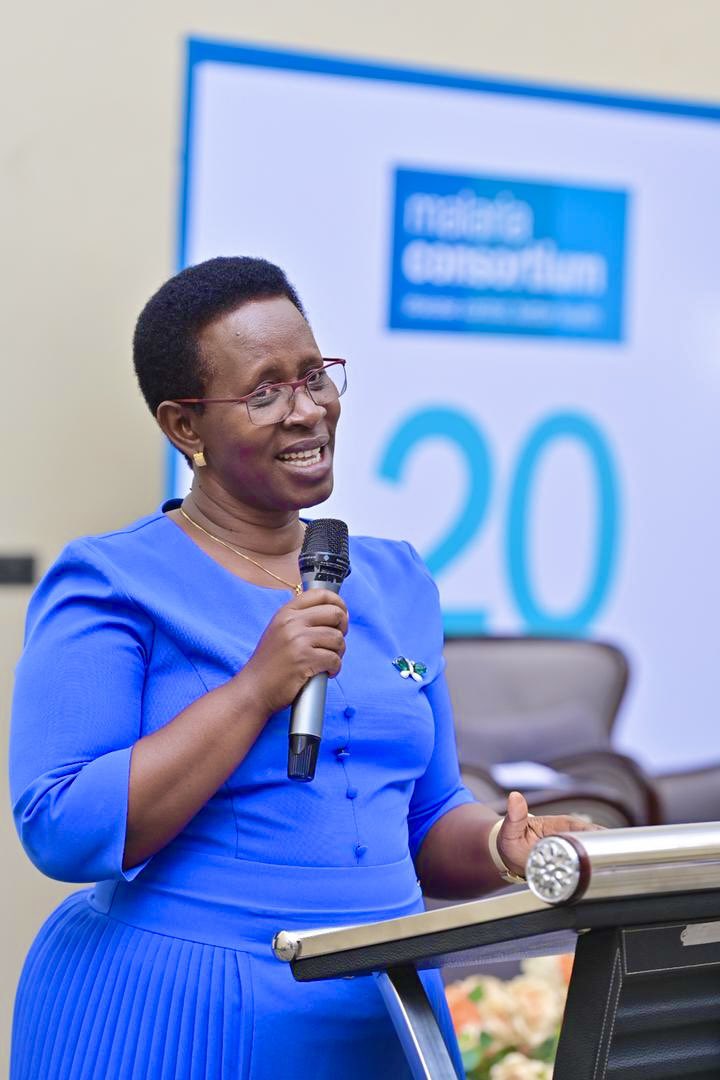
The Permanent Secretary at the Ministry of Health, Dr. Diana Atwine, has announced that the government plans to introduce a malaria vaccine for children in early 2024, as malaria continues to affect children in the country.
Dr. Atwine made this statement during the 20th-anniversary celebration of the Malaria Consortium, a non-profit organization dedicated to the prevention, control, and treatment of malaria and other communicable diseases.
“We are going to train people and we are going to introduce the vaccine early next year and this vaccine will help to reduce the severity especially in children. Initially we are targeting the children because they are the worst hit by malaria,” she said.
Over the past two decades, the Malaria Consortium has played a crucial role in reducing the malaria burden in Uganda and across Africa and Southeast Asia.
Dr. Atwine emphasized that this milestone represents two decades of unwavering commitment and significant progress in the fight against malaria in Uganda.
She acknowledged the Malaria Consortium as a critical partner in Uganda's efforts, collaborating with the government, health workers, communities, and various stakeholders.
Their innovative approaches, research endeavors, and direct interventions have played a vital role in reducing the impact of the disease across the nation.
Dr. Atwine highlighted the previous achievements made in reducing malaria prevalence from 49% to 9% in the country, but she also noted a recent increase in the trend over the last three years.
Dr. Atwine questioned why malaria, as the biggest killer in Africa, has not received the same level of attention as other diseases, such as Covid-19.
"It has killed more people than Covid-19 has killed worldwide. There has been this perception,and people overlook it, and in that process, Malaria has continued to claim lives of many people," she said.
She emphasised that malaria is not only a health issue but also an economic one, with a significant financial burden on treating the disease.
“Malaria is an economic disease, as I always tell people. We spend quite a lot of money on treating malaria. Malaria is the biggest contributor to maternal mortality and the biggest killer for children under the age of 5," she said.
The introduction of the malaria vaccine in early 2024 aims to reduce the severity of the disease, particularly in children
Initially, she said the focus will be on children as they are most affected by malaria, but the age group will be expanded as more vaccines become available.
"Until just recently when we got the vaccines for malaria, which in a way is still limiting because we can't easily access these vaccines as we want. No single world leader challenges people; how come malaria is still the biggest killer in Africa?" she queried.
Dr. Atwine stressed the importance of strengthening household health and individual responsibility in preventing malaria.
She pointed out that climate change, including factors like flooding, has contributed to the increase in malaria cases.
Additionally, she attributed the rise in malaria to the changing dynamics of mosquitoes, including their mutations and resistance to current treatments. She emphasised the importance of clearing the environment, using mosquito nets, and spraying chemicals in houses to prevent malaria.
The Ministry of Health, along with other interventions, is distributing treated mosquito nets and conducting indoor spraying in districts with a high malaria burden.
Furthermore, over 330,000 doses of the WHO-recommended RTS,S malaria vaccine have been shipped to Africa, with a vaccination program being implemented by GAVI, the Vaccine Alliance, WHO, and UNICEF.
This initiative is seen as a game-changer in the fight against malaria and is expected to save the lives of hundreds of thousands of children each year.
The fight against malaria in Uganda is crucial due to the country's high malaria transmission rates in most parts, primarily due to its climate.
Dr. Godfrey Magumba, East & Southern Africa Programmes Director at The Malaria Consortium said the Malaria Consortium, which has been operating in Uganda for twenty years, has contributed significantly to the reduction of malaria incidence from 62% in 2004 to 9% in 2019.
"The numbers we are celebrating today are highly encouraging because they demonstrate significant progress since we initiated our work here twenty years ago. In collaboration with other key stakeholders, we have successfully averted over 23 million malaria episodes through various means. However, our work is not yet complete," he said.
He noted that their multi-faceted approach, which includes innovative research, evidence-based interventions, and community engagement, has been instrumental in achieving this remarkable progress.
He said the consortium remains committed to advancing malaria control efforts through new technologies, partnerships, and sustainable health solutions.
He expresses their gratitude to all partners, stakeholders, health workers, and communities who have contributed to their mission over the past two decades, and they continue to work towards a healthier, malaria-free world