

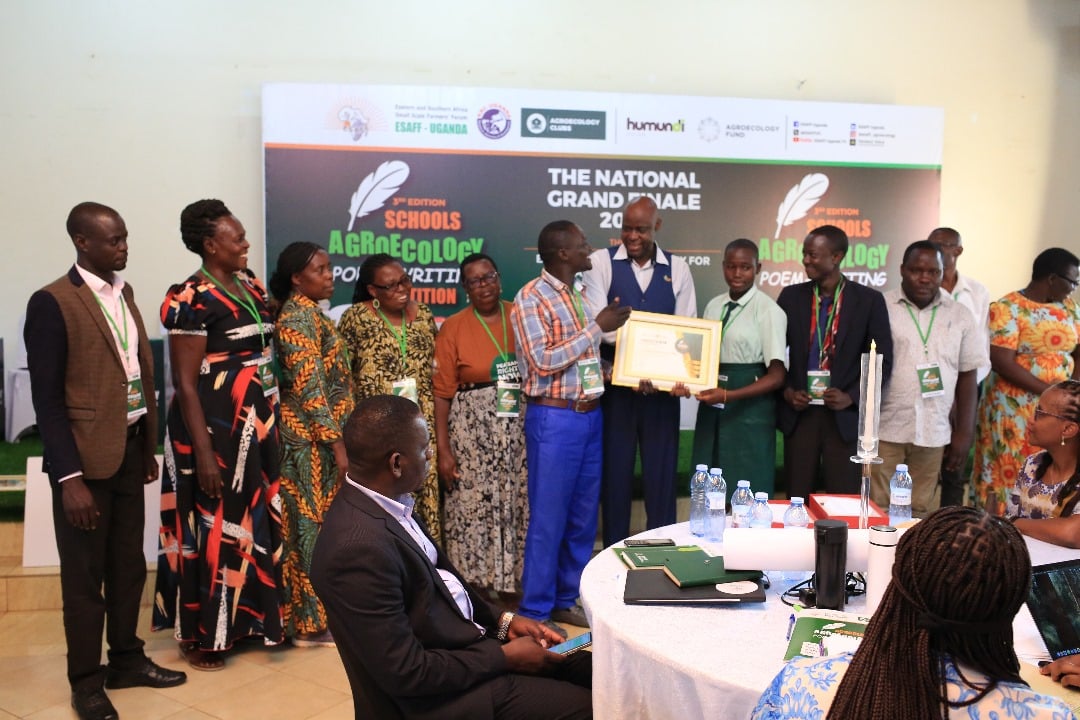
NAMUGONGO — Calls for a shift towards agroecology in Uganda’s agricultural sector grew louder on Friday, September 26, 2025, during the National Schools’ Agroecology Poem Writing Competition held at Namugongo Kyoto.
The event brought together finalists from schools across Uganda, showcasing poems about food systems, environmental protection, and sustainable farming.
Organized by the Eastern and Southern Africa Small Scale Farmers Forum (ESAFF Uganda) and partners, the competition sought to nurture creativity among learners while also raising awareness about agroecology as a national priority.
Hakim Baliraine, ESAFF Uganda National Chairperson and a small-scale farmer from Mayuge, described agroecology as the only viable alternative to the damaging consequences of chemical-driven farming.
“Agroecology is not just about crops; it is about the whole food system,” Baliraine said.
“We look at livestock, people, crops, biodiversity, and even policies that shape production. If these policies do not support agroecological systems, then we are setting ourselves up for crisis.”
Baliraine highlighted ESAFF’s promotion of agroecology through community-based schools, curriculum partnerships with universities, and school laboratories.
He stressed the importance of involving young people, describing them as “citizens of now and tomorrow” who must help address climate challenges.
He also criticized Uganda’s education system for downplaying agriculture, which remains optional in secondary schools, unlike compulsory subjects such as English.
“If someone speaks English very well, so what? Why can’t agriculture — the foundation of food and life — be compulsory?” he asked, urging the Ministry of Education to integrate agroecology into the curriculum.
Baliraine further called for better coordination across government ministries, warning that siloed approaches and budgetary priorities tilted towards conventional farming undermine agroecological progress.
Government Response
Representing the Ministry of Agriculture, Animal Industry and Fisheries, Sir Sunday Bob George, the focal person for organic agriculture and agroecology, reassured participants that government remains committed to sustainable farming.
“As government, we have not folded our hands,” he said.
“We developed the National Organic Agriculture Policy in 2019, and we are finalizing a national agroecology strategy. These policies create an enabling environment for sustainable farming.”
Bob emphasized that food security requires multiple approaches.
“You cannot feed the increasing population with only one technology,” he said.
“We need multiple approaches. But going forward, we must ensure that whatever we do conserves agricultural biodiversity and does not spoil nature.”
Dr. Grace Baguma, Executive Director of the National Curriculum Development Centre (NCDC), who officiated at the event, commended ESAFF Uganda for championing agroecology through innovative school programs.
She said the competition aligns with the new lower secondary curriculum, which prioritizes project-based and practical learning.
“This intervention is helping us to support the expectations of the new curriculum, especially projects that are agricultural, agroecologically, and environmentally based,” Dr. Baguma noted.
“It focuses on what children are manipulating in their environment and doing things that add value to their lives and to the communities where they live.”
The Namugongo event reinforced the view that agroecology is not simply a farming method but a holistic system connecting health, environment, education, and sustainable livelihoods.
With schoolchildren using poetry to voice the urgency of change, experts urged Uganda to empower its younger generation to lead the transition to a healthier, climate-resilient future.